

The lead went cold. Three follow-ups. No response. Your rep marks it unresponsive and moves on.
Six weeks later, the curriculum director emails asking if you’re still taking demos. Your rep has already recycled the opportunity. Someone else gets the deal.
This happens constantly in K-12 sales, and it’s almost never about your product, your pitch, or your cadence. The contact didn’t go quiet because they ruled you out. They went quiet because the K-12 academic calendar made engagement impossible. Nobody on your team knew the difference between a buyer who is done and a buyer who is dormant.
In most B2B markets, non-response after three attempts is a meaningful signal. In K-12, it’s often just March.
Most edtech sales teams are running a 60-to-90-day SaaS cadence against a 12-to-18-month district buying cycle. The timing is wrong. The follow-up rhythm is wrong. And the pipeline math is wrong because of it. Understanding why K-12 buyers stop responding, and when they’ll come back, is one of the highest-leverage things a revenue team in this market can learn.
What K-12 Silence Actually Looks Like
I keep hearing the same version of this story from sales leaders at edtech and education companies. A contact engages meaningfully in October: opens emails, requests materials, joins a discovery call. Then goes completely dark in December. The rep tries again in January. February. March. Nothing. The rep concludes the deal is dead.
The contact surfaces in September: “We’re starting our evaluation process. Can we get something on the calendar?”
That wasn’t a lost deal. That was a calendar problem.
The pattern shows up across deal stages and company sizes:
A district instructional coach downloads three resources in November, attends a webinar, asks a pointed follow-up question. Goes silent by February. The rep marks them cold. The coach resurfaces in August asking for a full demo.
A sales leader at a mid-size edtech company sends a promising prospect a competitive analysis in April. No reply. Follows up twice. No reply. Assumes the district chose a competitor. The district’s procurement director calls in September: “We’d like to move forward.”
A regional publisher negotiates a pilot scope with a district in January, goes three months without a response, restarts in September, and closes by November, exactly 14 months after first contact.
None of these are anomalies. They are the K-12 buying cycle running on schedule.
Why Does K-12 Buyer Engagement Follow Such a Predictable Pattern?
Most K-12 districts finalize budgets in spring, meaning vendor relationships need to be built six to twelve months before the contract is signed. The academic year creates four structural silence windows that repeat reliably, regardless of deal stage or relationship depth.
Summer (June–August): Staff transitions, professional development, and pre-year logistics dominate. Decision-makers are partially unavailable or have changed roles. No one is starting a vendor evaluation in July.
September Ramp-Up: School is opening up. Staff and students are still settling in, and administrators have no bandwidth for a new vendor conversation. Stay visible, but don’t push. This window closes fast, and October opens the door.
Fall Awakening (October – November– Early December): The one genuine engagement window. New budgets, new priorities, new energy. This is when dormant contacts surface, but only if you’ve stayed visible without annoying them in the months they couldn’t respond.
Holiday Dark (Mid-December – Second Week of January): The engagement window closes for the break. Staff are out, decision-makers are unreachable, and pushing for meetings now reads as tone-deaf. Go quiet respectfully and pick back up once districts return.
Budget Planning (January – March): Districts return from break and move into the sessions where next year’s budget actually gets shaped. This isn’t a silence window. It’s the payoff for the relationship you built in the fall. Curriculum directors and chief academic officers are identifying next year’s challenges and looking for vendors who already understand them. If you built visibility in October through early December, this is where it converts.
Budget Lock-Down (April–May): School boards finalize next year’s budget. If you’re not already part of the conversation by now, you’re negotiating for scraps in a budget that’s effectively closed.
Scott Noon of Midday Advisors calls this the K-12 Silence Calendar: the four predictable periods each academic year when engagement drops not because of lost interest but because of structural calendar constraints. It’s not a buyer behavior problem. It’s a timing mismatch between how districts work and how most edtech teams sell.
See the Whole Year at Once
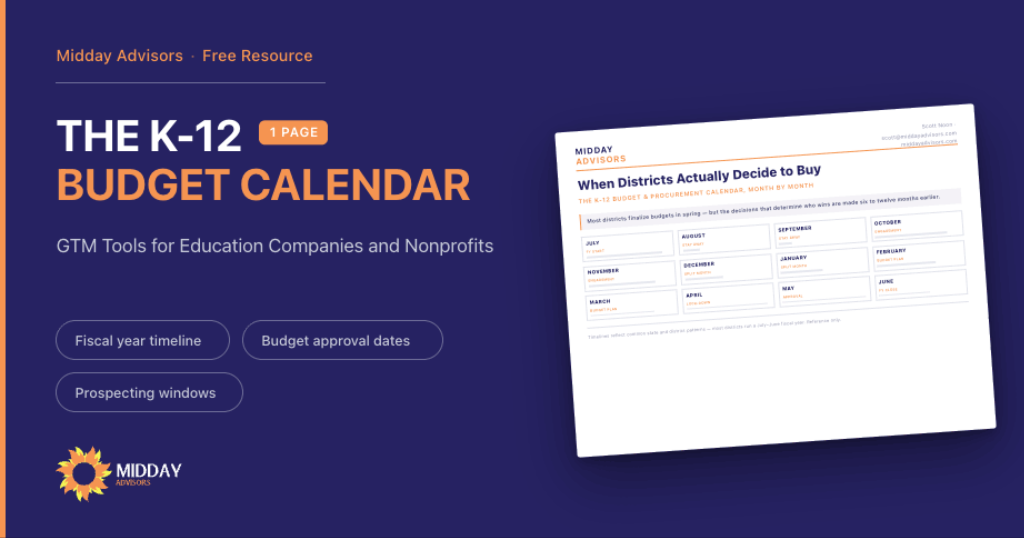
The K-12 Silence Calendar tells you when districts go quiet and when they don’t. This one-page calendar puts the full cycle in front of you, month by month, with the specific move to make in each one.
Why Do Sales Teams Keep Misreading K-12 Silence as Rejection?
Most sales training was built for markets with 60-to-120-day buying cycles. In those markets, non-response after three attempts is a reasonable signal to move on. MEDDIC, challenger selling, SPIN: the major frameworks all assume a cadence where sustained silence means disengagement.
In K-12, that logic produces false negatives at scale.
A buyer 14 months from purchase doesn’t respond to follow-up emails in April. Not because they’ve ruled you out, but because they’re in a spring planning cycle with no runway to engage a new vendor. The rep interprets that silence through the lens of a 90-day market. They cut the opportunity. They move on.
The contact comes back in September and finds a different vendor waiting. Not because that vendor is better. Because they understood the calendar.
The misread is expensive and it compounds. Every false negative in Q2 is a relationship handed to whoever maintained visibility long enough to be remembered when fall starts.
How to Work With the K-12 Silence Calendar
The fix isn’t more follow-up. It’s better timing with less friction across the full 12-to-18-month cycle.
Map outreach to the academic calendar, not the corporate fiscal year. Most edtech companies treat September–December as “fall push.” In K-12, November and December are the worst months to push for decisions. The right timeline runs backward: relationships built in October through early December lead to budget-planning conversations in January through March and lock-down decisions in April, just before summer downtime. If you’re pushing for a close in November, you’re either three months early or seven months late.
Distinguish dormant from dead. A contact who engaged meaningfully at any point (opened a personalized email, attended a webinar, asked a substantive question) is almost certainly dormant, not done. A contact who never engaged is a different conversation. Build a second CRM status: dormant-calendar. It means still qualified, still signaling interest by prior behavior, currently in a K-12 silence window. Route it to a October re-engagement workflow, not a recycling workflow in April.
When they go quiet, shift from ask to value. The worst thing a seller can do during a K-12 silence window is send three more “just checking in” emails. Those emails train the contact to filter you out. When a prospect goes quiet, switch from meeting requests to value delivery: a short relevant insight, no reply required. A useful take on a policy trend. A resource related to something they mentioned. Something that keeps your name associated with useful, not persistent.
The goal during silence windows isn’t to get a meeting. It’s to be the vendor they remember when September starts.
Build explicit re-entry touchpoints. A September outreach that acknowledges the gap isn’t weakness. It’s proof that you understand how their calendar works. “We talked in the fall. I know spring and summer are busy. Wanted to reconnect as the new year gets underway.” Districts notice the difference between a rep who treats them like a pipeline number and one who operates like they’ve actually sold into K-12 before.
Silence is the time to build demand, not chase it. See what K-12 demand generation looks like before a rep ever calls.
Getting This Right Changes More Than Your Follow-Up Rate
The K-12 Silence Calendar isn’t just a reminder to wait. It’s a framework for redesigning how a revenue team builds pipeline, defines engagement, and measures rep performance in a market with a fundamentally different time horizon.
Teams that understand it stop penalizing reps for “stale” opportunities that are just mid-cycle. They build nurture content for the long windows when buyers can’t respond. They hire sellers who know how to stay warm over 14 months without burning the relationship. They measure deals in academic-year cycles, not fiscal quarters.
K-12 buyers aren’t ghosting you. They’re following a calendar you haven’t learned yet.
Learn more at How K-12 Districts Actually Buy: A Field Guide for Education Companies.
If your team is working through K-12 go-to-market timing and wants to pressure-test your outreach strategy, let’s talk. You can also see how Midday Advisors works with K-12 education companies.
Scott Noon is the founder of Midday Advisors, a K-12 go-to-market advisory firm.
Frequently Asked Questions
District contacts go quiet during three predictable windows: September, while schools ramp up for the new year; mid-December through the second week of January, for winter break; and briefly after April’s budget lock-down, once decisions are made. October through early December and January through March are active engagement windows, not silence. Non-response outside the quiet periods reflects calendar constraints, not disengagement.
October through early December is the primary window for building visibility with new contacts: administrators are genuinely available and shaping next year’s priorities. January through March isn’t secondary. It’s when that visibility converts, as districts run budget-planning sessions and look for vendors who already understand their challenges. September is the wrong time to push, and by April the budget is effectively locked.
Most K-12 districts finalize budgets in spring, meaning vendor relationships need to be built six to twelve months before the contract is signed. The full cycle from first engagement to signed contract commonly runs 12 to 18 months, with multiple silence periods built into the academic calendar.
Mark the contact dormant-calendar rather than dead, stop sending meeting requests, and shift to value delivery: short, relevant insights with no ask attached. Build a October re-entry touchpoint timed to the start of K-12’s genuine engagement window. The goal during silence is to stay visible without becoming a reason they ignore your emails.
The K-12 Silence Calendar is a framework developed by Scott Noon of Midday Advisors that maps three quiet periods each academic year: September ramp-up, the mid-December-to-early-January holiday break, and the days just after April’s budget lock-down, bookending two active windows: October through early December, when vendors build the visibility that pays off, and January through March, when districts run the budget planning sessions where that visibility converts.