

Most education companies and nonprofits don’t have a marketing leadership problem. They have a marketing vacancy problem — and they’re filling it wrong.
I call this the Marketing Vacancy Problem: the senior marketing seat is effectively empty, so the work falls to whoever is nearest — a founder, a program director, a VP of Sales — none of whom were hired to carry it. The fix isn’t more hands. It’s putting senior judgment back in the seat.
Putting senior judgment back in the seat is the Seat move in how we work, the middle step of our Fluency-First Method: read the structure, fill the seat, then steer the go-to-market.
The pattern shows up everywhere in K-12. A founder who built the organization on relationships now owns the pipeline. A program director who knows the work better than anyone is writing campaign copy in their spare time. A VP of Sales is managing an agency that has no idea what a Title I school actually looks like from the inside.
The work is getting done. Sort of. But nobody with senior marketing judgment is steering it.
A fractional CMO is the direct answer to that problem. This page explains what the role actually is, what it costs, what to look for — and when it makes sense to bring one in.
What Is a Fractional CMO?
A fractional CMO is a senior marketing executive who works with your organization on a part-time or project basis rather than as a full-time employee.
The “fractional” refers to the time commitment — typically 10 to 20 hours per week — not to the seniority or scope of the work. A fractional CMO operates at the same strategic level as a full-time chief marketing officer: setting direction, building infrastructure, managing vendors and internal teams, and owning results. They just do it across two or three organizations simultaneously rather than one.
The model has grown significantly in the last decade. What was once a workaround for early-stage startups has become a standard operating model for growth-stage companies that need experienced leadership without the full-time overhead.
Why Education Companies and Nonprofits Are Underusing Fractional Leadership
The education sector lags the broader market here, and not for lack of need.
The reluctance usually comes down to three assumptions — all of which are worth examining.
“We can’t afford a CMO.” A full-time CMO at a growth-stage education company costs $180,000 to $250,000 in base salary before benefits, equity, and management overhead. A fractional engagement at comparable seniority typically runs $6,000 to $15,000 per month. For most organizations, that’s a real number — but it’s a fraction of the alternative, and it unlocks capacity that a junior hire or agency retainer simply cannot provide.
“We don’t have enough work for a CMO.” This is almost always inverted. Organizations that feel this way typically have too much unfocused marketing activity and not enough strategic judgment applied to it. A fractional CMO’s first job is usually to stop things, not start them — to identify what’s not working, why, and what to do instead. This is also why hiring a full-time chief marketer too early often backfires: without a strategy in place, a senior hire inherits the same unfocused activity at a much higher cost. (More on that in the case against hiring a full-time CMO before you have a strategy.)
“We need someone who understands education.” This one is legitimate. The K-12 procurement cycle is unlike almost any other market: most districts finalize budgets in spring, which means vendor relationships need to be built six to twelve months before a contract is signed. Content that resonates with a district curriculum director reads nothing like content aimed at a startup founder. Education-sector marketing requires genuine domain knowledge — not just general marketing competence adapted to a new vertical.
Scott Noon and the team at Midday Advisors work exclusively with education companies and nonprofits. That’s not a positioning statement. It’s a constraint that makes the work better.
What Does a Fractional CMO Do Day-to-Day?
This is where expectations often go sideways. A fractional CMO is not an agency. They’re not a content producer. They don’t manage your social media calendar.
What they do:
- Diagnose what’s actually driving — or stalling — pipeline and revenue
- Define the audience, message, and channel strategy the organization needs
- Build or rebuild the marketing function: hiring, vendors, tools, process
- Hold the team accountable for results, not activity
An outside senior voice also counters a quiet risk in growing organizations — the Seniority Trap, where the most senior leaders are the last to hear what’s actually happening in the market. A fractional CMO sits close enough to the work to bring that signal back into leadership conversations.
The day-to-day looks like: a weekly leadership sync, regular reviews of campaign performance, direct management of whoever is executing the work, and the occasional deep dive into a specific problem — a launch, a competitive response, a market-entry question.
What changes when a fractional CMO is in the seat: decisions get made. Work gets directed. The organization stops guessing about what marketing is supposed to accomplish.
How Do I Find the Right Fractional CMO?
The right fractional CMO for an education company is not the same as the right fractional CMO for a fintech startup.
Look for three things:
Sector fluency, not just sector familiarity. There’s a difference between someone who has worked with a school district once and someone who has built marketing infrastructure inside the K-12 ecosystem. Ask specifically: What was the sales cycle? Who were the decision-makers? How did you handle the budget calendar? Vague answers are a signal.
Strategic scope, not executional instinct. Some marketers who hold CMO titles are, in practice, senior managers of execution. A true fractional CMO should be able to diagnose your positioning, identify the structural reasons your current marketing isn’t converting, and set a direction — not just take tasks off your plate.
A model that fits your stage. A fractional CMO who works best with pre-product-market-fit startups may not be the right partner for a Series B company building a repeatable enterprise sales motion — and vice versa. Ask for specifics about past engagements at similar stages.
At Midday Advisors, initial conversations start with a diagnostic, not a pitch. The goal is to understand what’s actually broken before recommending anything.
Is a Fractional CMO Right for Your Organization?
Not always. Here’s a quick read.
When marketing stalls, the reflex is to hire someone full-time to own it — but the answer usually isn’t a full-time hire, at least not first. A fractional CMO makes sense when:
- Revenue is growing but marketing hasn’t kept pace with the business
- The founder or executive director is still the de facto CMO and needs to stop being
- You have marketing activity but no marketing strategy
- You’re preparing for a significant growth moment — a new product, a new market, a fundraise — and need senior judgment to position it correctly
It’s probably not the right move when:
- You have no marketing infrastructure at all and need someone to build it from scratch full-time
- You’re pre-revenue and the founder’s direct selling is the actual go-to-market
- Your organization’s challenges are primarily operational, not market-facing
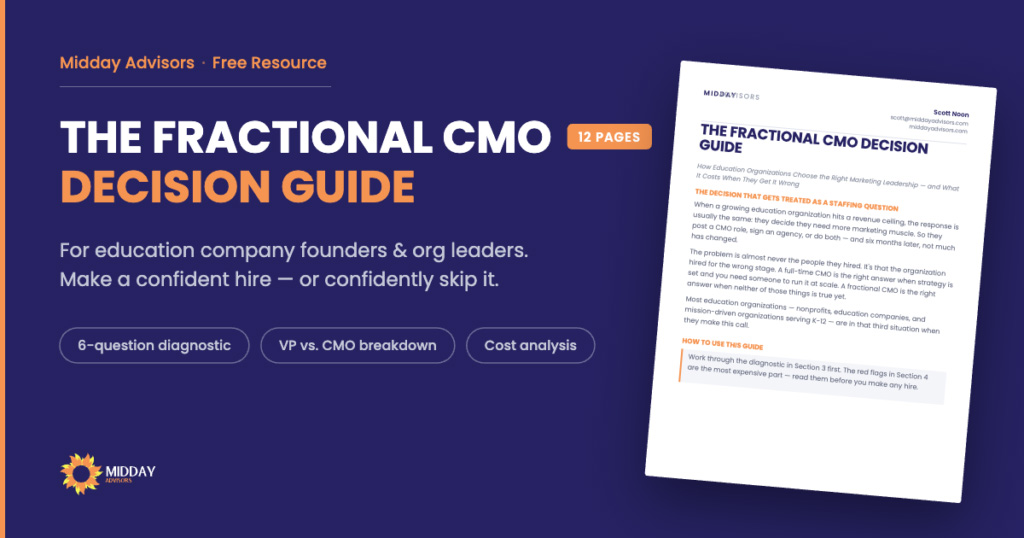
Learn more by downloading the Fractional CMO Decision Guide here.
If your organization is dealing with a version of this, let’s talk.
Frequently Asked Questions
A fractional CMO is a senior marketing executive who works with an organization part-time — typically 10 to 20 hours per week — providing strategic leadership comparable to a full-time chief marketing officer at a fraction of the cost.
A consultant typically delivers a defined output — an audit, a strategy document, a campaign plan — and exits. A fractional CMO is embedded in the organization’s leadership, owns outcomes over time, and manages the team and vendors doing the execution work. The accountability is ongoing, not project-scoped.
Engagements typically range from $7,000 to $15,000 per month depending on scope, seniority, and hours. That compares to $180,000 to $250,000 in base salary for a full-time hire at comparable seniority — before benefits and overhead.
Education organizations face a procurement cycle and a buyer psychology that most generalist marketers don’t understand. A fractional CMO with genuine K-12 domain knowledge can compress the learning curve that kills most education GTM efforts — and bring the strategic infrastructure that historically only large publishers and platforms have been able to build.
If you don’t yet have a marketing strategy, start fractional. Hiring a full-time chief marketer before the strategy exists usually means paying a premium for someone to untangle unfocused activity — work a fractional CMO can do first, faster, and for less. Move to full-time once the function is built and the workload genuinely fills a full-time seat.