When K-12 marketing stalls, the instinct is to fix the marketing. It’s almost always the wrong place to look.
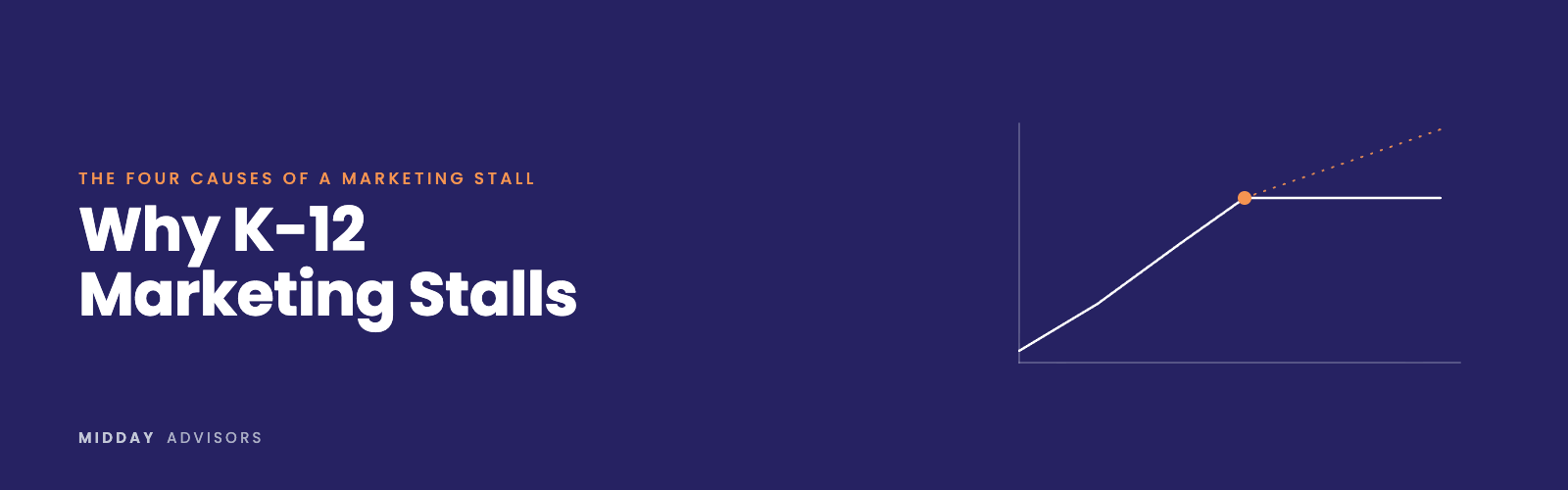
The pattern is familiar in education organizations of every size. The team is working hard. The content calendar is full. The newsletter goes out, the webinar runs, the social posts ship. And the pipeline stays quiet. So leadership does the logical thing: rewrite the copy, refresh the website, hire another marketer, push out more content. The output goes up. The results don’t. That’s the tell. When more and better marketing doesn’t move the number, the cause isn’t the marketing — it’s something upstream that no amount of execution can fix.
I’ve watched this play out across enough education companies to see the same four causes underneath nearly every stall. I call them the Four Causes of a K-12 Marketing Stall: a clarity gap, a coordination gap, a focus gap, and a market-fit gap. Each one looks like a marketing problem from the outside. None of them is solved by producing more. This guide walks through all four, how to tell which one you have, and what actually fixes it.
Is Your K-12 Marketing Actually Broken — or Just Misaligned?
Most of the time it isn’t broken at all. It’s misaligned — the parts are working individually but not pulling in the same direction. The distinction matters because a broken thing gets repaired and a misaligned thing gets coordinated, and those are completely different jobs.
A marketing problem gets fixed by improving the marketing: better copy, better design, better targeting. A coordination problem gets fixed by getting sales, product, leadership, and marketing aligned on who you’re for and what you’re saying. Pour marketing effort into what is actually a coordination failure and you just make the misalignment louder. This is the core of why K-12 marketing isn’t broken, it’s misaligned — and naming it correctly is half the fix.
The visible symptom is usually a sense of scatter. Lots of activity, no through-line, every channel telling a slightly different story. That feeling has a structural cause, not a discipline one, which is why K-12 marketing feels scattered and how to fix it. A full calendar is not a strategy. Until there’s a single clear answer to who you serve and what you want them to believe, more activity just spreads the confusion wider.
Why Doesn’t Producing More Content Fix a Stall?
Because the problem is rarely a shortage of content — it’s a shortage of clarity, and more content built on an unclear message just produces more noise. Volume amplifies whatever is already there. If the message isn’t sharp, you’re scaling a blur.
When marketing isn’t landing, the reflex is to produce: more blog posts, more case studies, more emails, more webinars. I’ve worked with education organizations publishing constantly and still going unheard, because the issue was never quantity. It’s why K-12 marketing doesn’t need more content, it needs more clarity. One clear, well-aimed piece outperforms ten unfocused ones.
This connects to a capacity trap that masquerades as a headcount problem. When a team is underwater, the diagnosis is almost always “not enough people.” Usually the team isn’t too small — it’s doing too much of the wrong work, spread thin across activity that doesn’t move the pipeline. That’s why your team isn’t too small, it’s doing too much. Adding a person to an unfocused system just gives you a bigger unfocused system.
When Is the Problem Market Fit, Not the Message?
When you’ve sharpened the message, focused the team, aligned the org — and it still isn’t landing. At that point the problem is usually deeper than anything marketing controls: the offer and the market aren’t matched, and no message fixes a fit problem.
When marketing underperforms, teams rewrite the copy first. Sometimes that’s right. More often, the harder diagnosis is that the product, the segment, or the positioning is aimed at a market that isn’t buying it the way you’ve built for. That’s when marketing isn’t landing and it could be market fit. When the fit is off, better marketing just makes the noise louder.
Market fit in K-12 is especially easy to get wrong because the standard go-to-market motion comes from SaaS and B2B, where it produces very different results. A funnel-and-demand-gen playbook run against a public-budget, multi-buyer, slow-cycle market doesn’t translate — which is why your K-12 go-to-market strategy isn’t broken, it’s built for the wrong market. The strategy can be executed flawlessly and still fail because it was designed for someone else’s market.
What Does Fixing a K-12 Marketing Stall Actually Take?
It takes diagnosing which of the four causes you have before you touch the marketing — and then fixing the upstream cause, not the symptom. The work is almost always strategic and structural, not creative. That structural read, naming the real cause before anyone touches the marketing, is the Read move in our Fluency-First Method, the first step in every Midday Advisors engagement.
Start by resisting the urge to produce. Before the next campaign, get a single, defensible answer to who you serve and what you want them to believe; that one decision resolves most clarity and scatter problems at once. Then look at alignment: are sales, product, and leadership actually agreed on the market and the message, or is marketing being asked to paper over a disagreement it can’t resolve? Audit where your team’s hours go and cut the activity that isn’t moving pipeline, rather than adding people to an unfocused system. And if all of that is solid and it still isn’t working, treat it as a fit question, not a message question — and be honest about whether the offer matches the market.
This is also where “innovation” gets misused. Stalled organizations often reach for a big new idea when what they need is coherence. Real innovation in education marketing is less about novelty and more about doing the fundamental things in a way that actually fits the market — which is what innovation strategy for education organizations actually takes. The companies that break a stall rarely do it with a clever campaign. They do it by fixing the system the campaigns run on, which is why so many education organizations struggle with marketing and what to do instead.
A stall is a signal, not a verdict. It’s telling you the problem is upstream of the work your team is pouring effort into — and that’s good news, because upstream problems are the ones a clear strategy can actually solve.
If your marketing is busy but the pipeline is quiet, the cause is probably one of these four, and it’s worth diagnosing before you spend another quarter producing. Let’s talk. You can see how we help education companies fix stalled marketing at Midday Advisors.
Frequently Asked Questions
Output rarely fixes a stall. If more content isn’t moving pipeline, the cause is usually upstream — unclear messaging, misalignment between teams, effort spent on the wrong work, or a market-fit gap. More volume just amplifies whatever is already there.
A marketing problem improves when you improve the marketing — better copy, design, targeting. A coordination problem doesn’t, because the real issue is that sales, product, and leadership aren’t aligned on who you serve and what you say. If better marketing isn’t moving the number, it’s coordination.
Often no. Underwater teams are usually doing too much of the wrong work, not too little work. Adding headcount to an unfocused system produces a bigger unfocused system. Audit where hours go and cut low-value activity before hiring.
When you’ve already sharpened the message, focused the team, and aligned the organization and it still isn’t landing. At that point the offer, segment, or positioning likely isn’t matched to the market — and no rewrite fixes a fit problem.
Because it’s built for SaaS and B2B markets with short cycles and single buyers. K-12 runs on public budgets, multiple decision-makers, and long timelines, so a funnel-and-demand-gen motion can be executed perfectly and still fail.