

Most education companies don’t lose K-12 deals because their product is weak. They lose because they’re selling into a buying process they’ve misread from the start.
The default playbook comes from B2B SaaS: identify your ideal customer, build a funnel, generate demand, move the lead through stages, close. It works in markets with short cycles and one decision-maker. K-12 is neither. A district purchase runs through public budgets, multiple people who each hold veto power, a political climate that shifts what’s fundable, and a calendar that decides months in advance when money can move at all. Run the SaaS playbook against that, and you get the symptom every education company knows: a strong product, a full pipeline, and a quarter that quietly misses.
This is a field guide to how K-12 districts actually buy. It pulls together what I’ve watched go wrong across education organizations and lays out the four realities that separate vendors who win consistently from vendors who stay stuck — what I call the Four Realities of K-12 District Buying: decision structure, the trust deficit, timing, and segmentation. Each one breaks a SaaS assumption. Together they explain most of the deals you’ve lost without ever getting a clear reason why.
Who Actually Makes the Decision in a K-12 District?
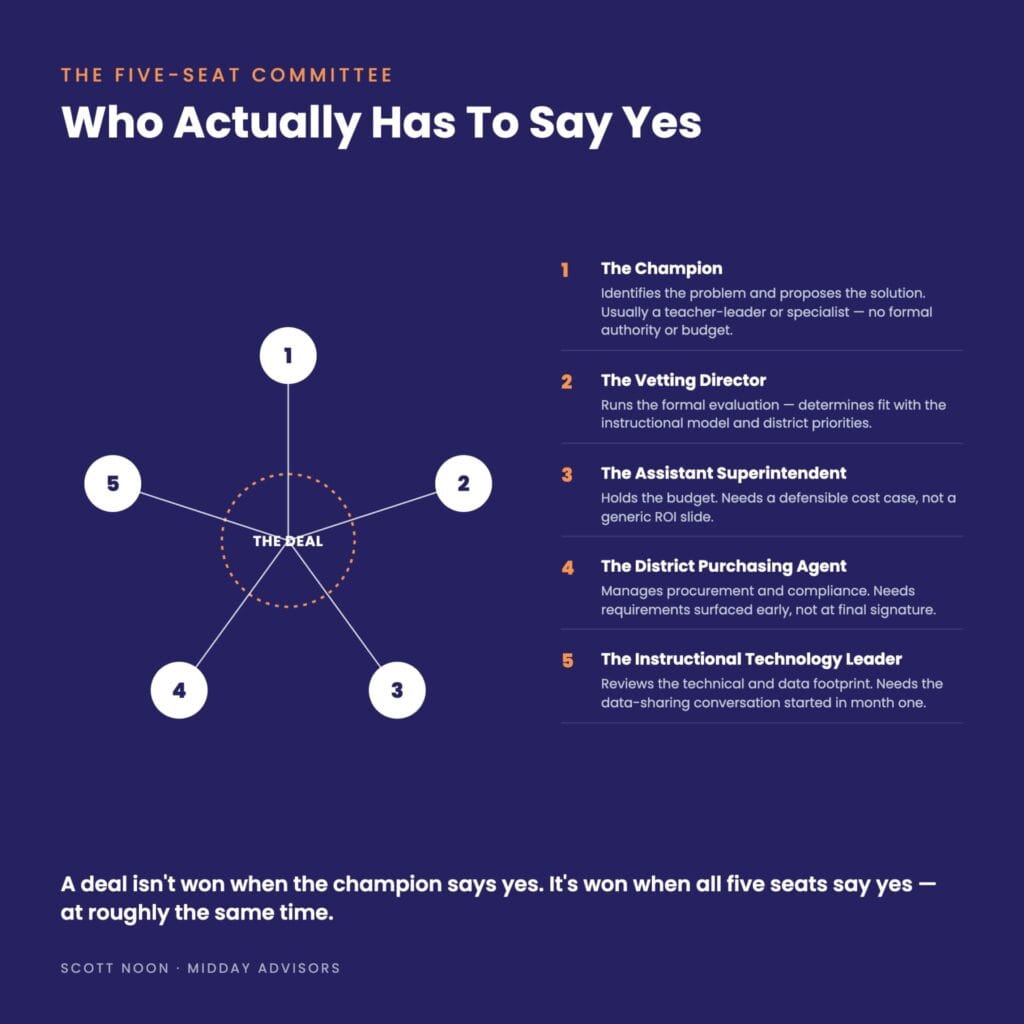
In most K-12 purchases, no single person decides. The person who signs the contract and the people who determine whether it gets used are different people with different incentives — and ignoring that split is the most expensive mistake a vendor can make.
A SaaS deal usually has an economic buyer you can identify and sell to. A district deal has at least two buyers who matter: the leader who approves and funds the purchase, and the practitioners — teachers, coaches, building administrators — who have to adopt it for the contract to survive renewal. Win the first and skip the second, and you book a contract that dies in implementation. I’ve watched this play out as a celebrated close that becomes a quiet non-renewal eighteen months later, which is exactly the two-buyer problem that turns a contract win into a renewal loss.
It’s also gotten harder to know who’s even in the room. The current political environment in K-12 has changed which programs are safe to fund, which words trigger scrutiny, and who gets pulled into a decision that used to be routine — a shift that has changed who makes decisions and how. Vendors still running their 2021 motion are getting surprised by objections that never used to come up.
The takeaway: map the full buying committee before you build the pitch. Sell only to the signer and you’re building a renewal loss into the contract.
Why Don’t K-12 District Buyers Trust Vendors?
Because they’ve been pitched at for years and have learned that most vendor claims don’t survive contact with their building. District leaders trust their peers far more than they trust the companies selling to them — and that gap shapes every conversation before you ever enter it.
The numbers are stark: B2B buyer research consistently shows buyers trust peers at around 73 percent and vendors at about 12 percent. Not 12 percent less — 12 percent, full stop. That’s the starting position for your outreach, and it explains why K-12 district buyers don’t trust vendors and what education companies should do instead. You are not opening from neutral. You’re opening from a deficit you didn’t create and have to close anyway.
The fastest way to deepen that deficit is to lead with your product. District leaders have a reliable early filter: if the first thing you tell them is what your product does, they stop listening. It reads as another vendor who hasn’t bothered to understand their problem — which is precisely why district buyers distrust vendors who lead with product. Trust is built by demonstrating that you understand the problem before you mention what you sell.
When Do K-12 Districts Actually Buy?
Earlier than most vendors think. By the time a vendor ramps up outreach in the fall, the decisions that govern most of a district’s discretionary spending for the year have already been made. Timing, not persistence, is what most campaigns get wrong.
Most companies selling to districts treat September like a starting gun — school’s back, leaders are at their desks, time to launch. It’s the wrong read. Districts finalize most budgets in the spring, which means the vendor relationships that win fall and winter contracts had to be built six to twelve months earlier. Selling hard in September is often selling into money that’s already committed. This is the K-12 budget cycle and what it means for marketing timing, and getting it right reorders your whole calendar.
Timing also explains a pattern that breaks many pipelines: the buyer who goes silent. A rep sends three follow-ups, gets nothing, marks the lead as dead, and moves on; then, six weeks later, the curriculum director resurfaces, asking for a demo, and the opportunity’s already been recycled. District silence is usually about their calendar, not their interest, which is why K-12 buyers stop responding and when they’ll start again. Read silence as a timing signal, not a verdict.
Why Is Your K-12 ICP Misreading the Market?
Because most ICP frameworks describe what a district is — enrollment, grades served, funding level — when what actually predicts a sale is how that district buys. A profile built on firmographics tells you who to target and nothing about how to win.
Education companies have imported the SaaS ICP wholesale and are systematically misreading their own market as a result. The typical K-12 profile is a demographic snapshot; it says nothing about decision structure, procurement path, or the political and budget realities above. That’s the K-12 ICP problem: you know who to target, you don’t know how they buy. The fix is to profile buying behavior, not just district attributes.
This is also where the phrase “built for K-12” earns or loses its meaning. Most companies use it to mean they’ve worked with districts before. Understanding the market in a way that changes how you sell means knowing the things that never show up in an industry overview — the unwritten procurement steps, the renewal politics, the difference between a pilot and a purchase. That’s what “built for the K-12 market” actually means in practice, and it’s the difference between a vendor districts tolerate and one they trust.
How Does K-12 Procurement and Contracting Actually Work?
Most district purchases of any size run through a formal procurement process — often an RFP — and increasingly through contracts that tie payment to results. These mechanics sit on top of the four realities, and vendors who treat them as paperwork rather than strategy lose deals they were otherwise winning.
The RFP is where a lot of education companies quietly lose. They treat it as a writing problem — sharper narrative, cleaner prose — when the vendors who win consistently treat it as a systems problem: a repeatable process for qualifying, positioning, and building relationships long before the RFP ever drops. That’s how to win more K-12 RFPs by building a system, not a response. By the time you’re writing the response, most of the outcome is already decided.
Contracting is shifting, too. Districts burned by tools that didn’t deliver are increasingly tying at least part of vendor payment to agreed student or program outcomes — a direct response to the trust deficit above. Understanding where this is headed, and what it means for how you sell and price, is the subject of outcomes-based contracting in K-12. The vendors who can speak credibly to outcomes will have an edge as this model spreads.
What to Do With the Four Realities
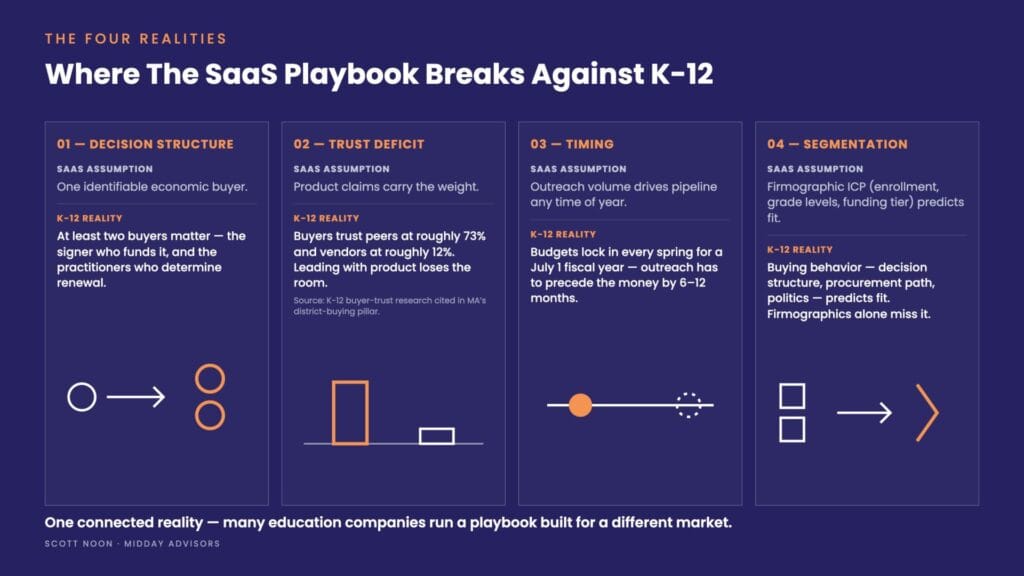
These four realities aren’t independent problems to solve one at a time. They’re one connected reality, and the companies that win in K-12 build their entire go-to-market motion around it instead of bolting fixes onto a SaaS funnel.
Start by mapping the real buying committee for your product — signer and practitioners — and build messaging for both, because the second group decides whether you renew. Lead every first conversation with the problem, not the product, so you start closing the trust deficit instead of widening it. Reset your calendar around the spring budget cycle so relationships are in place six to twelve months before money moves, and treat buyer silence as a timing signal rather than a lost deal. And rebuild your ideal customer profile around buying behavior, not firmographics, so your team spends its energy on districts that can actually move.
None of this is faster than the SaaS playbook. It’s slower, more relationship-driven, and less satisfying to a dashboard. It’s also what actually works in a market where the buyer trusts you at twelve percent and the budget closed last spring. Building the whole aligned sales and marketing motion around how districts buy is the Steer move in our Fluency-First Method, where marketing and sales finally point at the same buyer, the same calendar, and the same number.
If your organization is selling into K-12 and the pipeline looks healthy but the contracts aren’t landing — or landing and not renewing — that’s usually a sign the go-to-market motion is built for the wrong market. Let’s talk. You can also see how we help education companies fix this at Midday Advisors
Map It Out
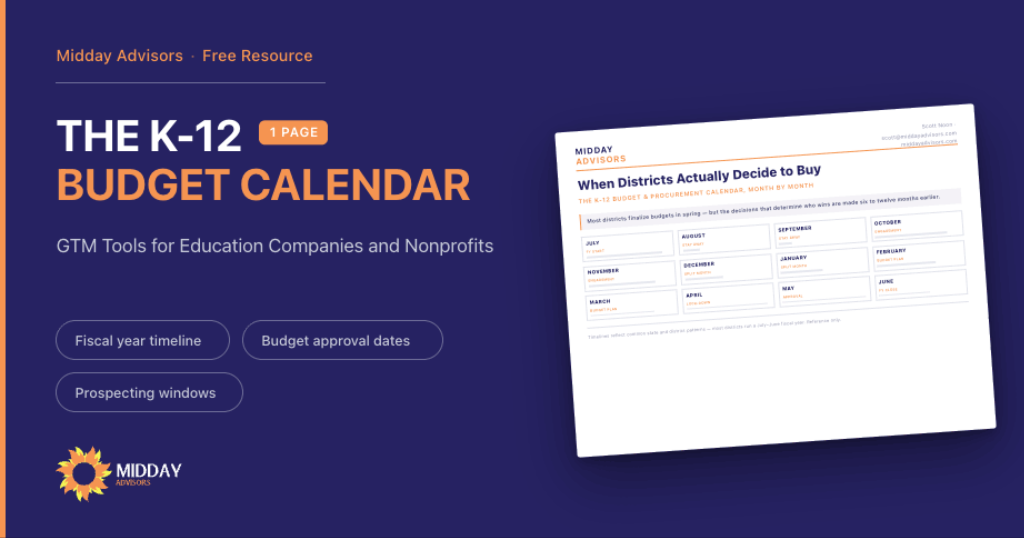
Districts run on a calendar most outside sellers never learn. Get the one-page reference — when to build visibility, when to go dark, and when the budget actually locks.
Frequently Asked Questions
There usually isn’t a single one. A funding leader approves and signs, but practitioners — teachers, coaches, building leaders — determine whether the product gets adopted and renewed. Selling only to the signer is how vendors win a contract and lose the renewal.
Six to twelve months before the contract would be signed. Most districts finalize budgets in the spring, so the relationships that win fall and winter purchases have to be built well before September.
Most often because of where they are in their budget and planning calendar, not because they’ve lost interest. District silence is often a pause in timing; buyers resurface when the cycle allows. Treat it as a signal, not a dead lead.
Buyers trust peers at roughly 73 percent and vendors at about 12 percent. Years of product-led pitches have trained district leaders to filter out vendors that lead with features rather than demonstrate they understand the district’s problem.
More than having sold to districts before. It means understanding the buying committee, procurement steps, budget timing, and political climate well enough to change how you sell — not just how you market.