
The K-12 District Buying Cycle: A Month-by-Month Map
September is not the starting gun. By the time a vendor ramps up outreach in the fall, the money that governs most of a district’s discretionary spending this year was settled months ago. Selling hard in September is often selling into dollars that are already committed. September is for building relationships that pay off in May or July.
The K-12 district buying cycle is the yearly sequence of planning, budgeting, bidding, and purchasing that decides when a district can say yes to a vendor. It runs on the district’s fiscal year, not your sales quarter, and in many districts that year runs July 1 to June 30. This map walks through it month by month so you can see where your opportunity actually sits. It is the working version of Fiscal-Year Fluency, one of the five levers in District-Fluent Marketing, and it sits inside the larger picture in the How K-12 Districts Buy guide.
Why Does the K-12 Buying Cycle Run Backward?
The cycle runs backward because the date that matters is not when the purchase order gets cut. It is when the budget locks. For most new spending, that date arrives months before the money moves, so the vendor’s calendar has to start at the lock and count back. We call that the Backward Calendar. Every district is on that same clock, which is why budget timing alone is not a targeting strategy.
I keep hearing the same sentence from sales leaders: “They loved the demo, and then they went quiet.” Most of the time the district did not lose interest. The calendar moved past the conversation. That is the pattern behind why K-12 buyers stop responding, and it costs a full year when the next budget window is twelve months away.
September Through November: Stay Visible, Then Open the Conversation
This is the window for next year’s money, not this year’s. In September, stay visible and do not push. Staff are absorbing the start of the school year. Engagement opens in October. From then through November, keep building the conversation with curriculum leaders so they have what they need to build your request into the budget they finalize in the spring. A vendor who starts a conversation in April is asking the district to find money that does not exist yet.
Use these months to learn which path the opportunity is likely on: an informal purchase or a formal bid. Ask who writes the specs. Conference season is one of the few times district buyers are physically in the room, so plan the conversations before the show starts. You are not selling yet. You are getting on the calendar.
December Through February: Finish Early, Then Make the Request Easy to Fund
Finish the relationship-building by early December, then go quiet. Districts are distracted and a new pitch gets ignored. In January, wait out the first week or two, then show up as a known partner. By February, be in the planning conversation.
District planning commonly runs January through March, and in some states the real decisions come earlier. Pennsylvania districts, for example, must adopt a preliminary budget by mid-February and a final budget by June 30, with most decisions on new spending settled by the February marker. Other states run similar timelines on different dates, so check the ones you sell in.
A request needs a champion, a number, and evidence. This is where Proof Before You’re Asked does its work: the case study that matches the district’s size and type has to be in the champion’s hands before the budget conversation, not after.
A sales leader might push back here and say districts will not talk budget in the fall, so there is no point starting early. That is fair. Many will not give you a number. But the conversation is not about the number. It is about being the vendor the champion already understands when the number gets set.
March Through June: The Number Is Set
By now the window to influence that year’s number has usually closed. Stop asking for new money and work the path your opportunity is on, because a district has two buying processes and you need to know which one you are in.
In March, submit specific, evidence-based RFP responses. April is lock-down, so move to close. In May, process paperwork fast. In June, confirm contracts and prepare for July 1.
Below a dollar threshold set by state or district policy, a purchase can move informally: a champion builds the case, a few people sign off, a purchase order gets cut. Above it, the purchase goes out to bid and is scored against a rubric, closer to a graded exam than a committee discussion. Reviewers score independently, and the vendor who shaped what the rubric rewards before it was written has the advantage. These thresholds are public record in state procurement codes and board-adopted purchasing policy, so read the actual policy instead of assuming one national number. This is Procurement Flow, and building an RFP system matters more than writing a better response.
July Through August: The Year Turns
In July, onboard the clients you won. In August, build relationships and do not pitch. The new fiscal year starts and approved purchases begin to move. A signed contract is not a won deal. It starts the renewal clock. Provisioning, rollout, and early support decide whether the people who use the product every day keep using it, and a license nobody logs into will not renew. This is Post-Sale Follow-Through, and it is where the two-buyer problem turns a contract win into a renewal loss.
Any Month: The Off-Calendar Window
Not every dollar follows the budget calendar. Three exceptions matter. Below-threshold purchases, often a few thousand dollars up to $10,000 to $25,000 depending on state and district policy, can move without a formal budget line. Building-level discretionary budgets let a principal or department head move faster than the central office. Grants, board-approved emergency spending, and end-of-year “use it or lose it” funds create buying windows unrelated to the fiscal calendar. We call this the Off-Calendar Window. A vendor who only understands the annual cycle will miss it, which is why smart sellers keep a simpler, lower-priced version of the offer available all year.
Why Do Vendors Keep Missing the Cycle?
Vendors miss the K-12 buying cycle because their sales process is built around their own quarter, not the district’s fiscal year. A rep measured on quarterly pipeline chases whoever answers the phone this month. The district answers on its own calendar. That is a system problem, not a people problem, and it is why the budget cycle changes marketing timing as much as it changes sales timing.
What Should You Do Differently?
Put every open opportunity on the district’s calendar, not yours. If a deal sits in March and you have not met the person who owns the budget, you are late, and your attention is better spent on districts where you are early.
Ask every contact two questions: which path is this purchase on, and who writes the specs or the rubric? If they cannot answer, you may be talking to someone who cannot buy. The five stakeholders every K-12 deal has to win over shows who else belongs in the conversation.
Read the district’s board-adopted purchasing policy before the first call. The threshold is written down, and it tells you which sales motion to run.
Keep one smaller offer ready for the Off-Calendar Window. A principal with a few thousand dollars and a mid-year grant do not care what month it is.
Midday Advisors builds this calendar into every go-to-market plan for education companies and nonprofits, through fractional CMO and CRO services and focused strategy audits. If you are weighing outside help, see how to choose a K-12 go-to-market partner, or fractional CMO for education nonprofits if you are a nonprofit selling to districts.
The Short Version
Count back from the budget lock, not forward from your quota.
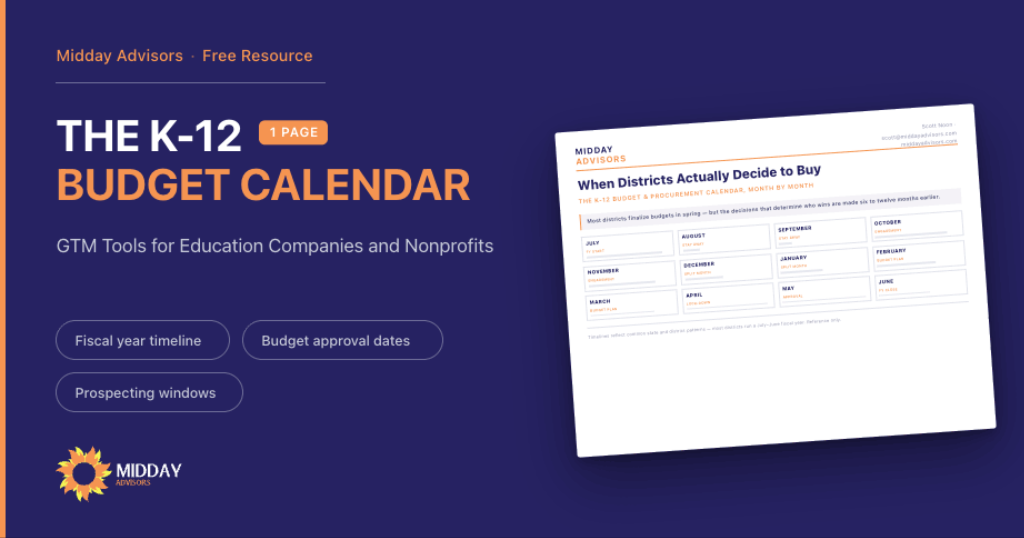
Districts run on a calendar most outside sellers never learn. Get the one-page reference: when to build visibility, when to go dark, and when the budget actually locks.
If your organization is dealing with a version of this, let’s talk.
Scott Noon is the founder of Midday Advisors, a K-12 go-to-market advisory firm.
Frequently Asked Questions
It is the yearly sequence of planning, budgeting, bidding, and purchasing that decides when a school district can buy from a vendor. It follows the district’s fiscal year, which in many districts runs July 1 to June 30.
For most new spending, the decisions are settled months before the money moves. Planning commonly runs January through March, and in Pennsylvania, for example, most decisions on new spending are settled by mid-February. Exceptions exist for below-threshold purchases, building-level budgets, and grant or emergency funds.
Six to twelve months before the contract would be signed. Starting conversations in the fall gives curriculum leaders time to build your request into the budget they finalize in the spring.
An informal purchase below a dollar threshold, where a champion builds the case and a few people sign off, and a formal bid above it, scored against a rubric by reviewers working independently. The threshold is set by state law and district policy.
It is Midday Advisors’ name for the buying opportunities that do not follow the annual budget cycle: below-threshold purchases, building-level discretionary funds, and out-of-cycle money like grants and emergency spending.