

Why campaigns that would work in any other market stall in this one.
K-12 education marketing is the work of reaching and persuading the people who decide what schools and districts buy. It is not a variant of B2B marketing. The buying unit, the money, and the calendar all behave differently, and marketing built on standard B2B assumptions reliably produces activity without producing revenue.
Most education companies arrive here after a year of doing everything right and watching none of it land. The content shipped. The booth was staffed. The pipeline filled with names that went quiet in March. The instinct is to blame execution, so the next year brings a new agency, a new campaign, or a new hire.
The cause is almost never effort. It is the Familiarity Trap: the assumption that knowing education is the same as being fluent in how districts buy. Most people in this industry came from a classroom or a school. That makes them familiar. Fluency is something else, and it is learned at the purchasing level, not the practitioner level.
What Is K-12 Education Marketing?
K-12 education marketing is how an education company earns the attention, trust, and budget of districts and schools. It spans positioning, content, demand generation, sales enablement, and proof, aimed at a committee rather than a single buyer.
The distinction that matters is that your user and your buyer are usually different people. A teacher may love your product and have no budget authority at all. A purchasing representative may approve it having never seen it work. Marketing that speaks only to the person who will use the product is marketing that never reaches the person who will pay for it.
Why Does K-12 Education Marketing Fail More Often Than It Should?
It fails because four structural realities govern the purchase, and standard marketing accounts for none of them. We call these the Four Realities: the Calendar, the Committee, the Politics, and the Scale.
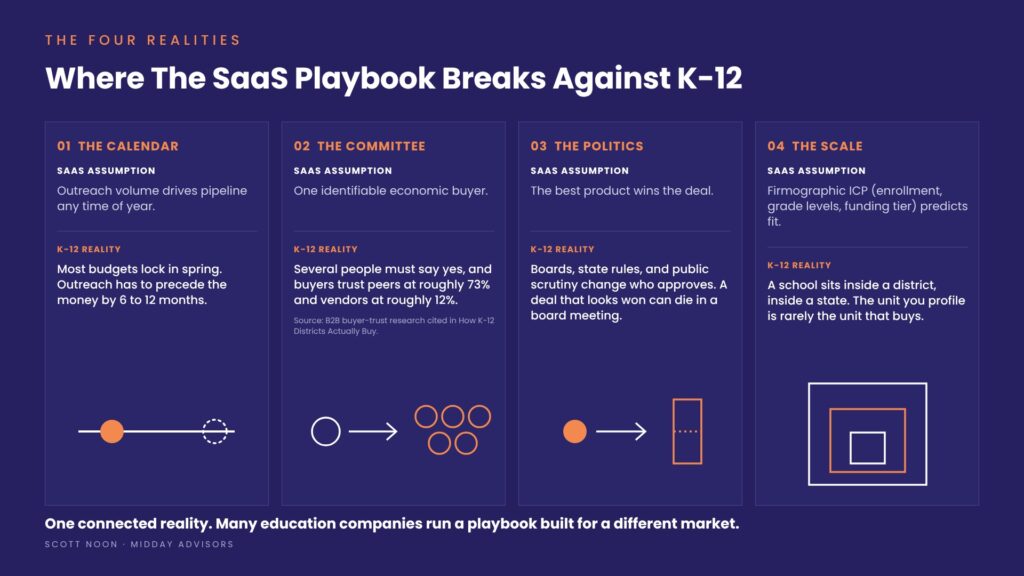
The Calendar is when money can move. Most districts build budgets in the spring for a fiscal year beginning July 1. A relationship that starts in February is competing for money committed the previous April. This is why a strong Q4 campaign can produce a pipeline that closes nothing: the pipeline is real, the money is gone.
The Committee is who has to say yes, and whether they trust you. Five seats recur: Champion, Curriculum Director, Assistant Superintendent, Purchasing Representative, and Instructional Technology Leader. Each has a different question and a different reason to say no. A trust deficit lives inside this reality, because district leaders trust peers far more than vendors, and most marketing is built to sound like a vendor.
The Politics is how the local environment changes who approves a deal and what they are willing to risk. The same product that sails through in one county becomes a board meeting in the next. This is not something you message your way around. It is something you plan for.
The Scale is that the unit you sell to is often not the unit that buys. School, district, and state each behave differently, and a product designed for a teacher but priced for a district has a structural problem that no campaign will solve.
Across all four sits Proof Debt, which is what happens when your evidence gets built after the question is asked. By the time the curriculum director requests efficacy data, the window has closed. Proof offered before it is requested is worth several times proof delivered on demand.
Where to Start
Our Guides work through each of these in depth. Start with the one that matches where you are stuck.
| If you are stuck on | Start here |
|---|---|
| Deals that stall with no explanation | How K-12 Districts Buy |
| Marketing that produces leads sales will not work | K-12 Marketing Strategy for Education Companies |
| Whether you need a marketing leader at all | What Is a Fractional CMO |
| Buyers who stop responding mid-cycle | Why K-12 Buyers Stop Responding |
| Wins that become renewal losses | The Two-Buyer Problem in K-12 |
If you have a specific question rather than a stuck point, the direct answers are collected on K-12 education marketing: direct answers to the questions vendors ask.
How Midday Advisors Works
Midday Advisors is a K-12 go-to-market advisory firm working with education companies and nonprofits in the $2M to $10M range. Scott Noon has spent more than thirty years on both sides of K-12 sales and marketing, most recently as Chief Partnerships Officer at UnboundEd.
The method is Fluency-First, and it runs in three steps. Read: diagnose the structure. Seat: put senior judgment in charge. Steer: align the go-to-market to how districts buy.
Three ways to work together:
- Strategy & Audit Engagements. A scoped project with a defined end, aimed at a specific question. Most work here starts this way.
- Advisory for Education Leaders. Ongoing senior judgment for a marketing or sales leader who has the role and needs someone who has done it before.
- Fractional CMO & CRO Contracts. Interim senior leadership when the seat is genuinely empty.
See Services for how each one is scoped.
Familiarity is not fluency, and districts can tell the difference long before you can.
If your organization is working through a version of this, let’s talk.
Scott Noon is the founder of Midday Advisors, a K-12 go-to-market advisory firm.
Frequently Asked Questions
Both markets have institutional buyers, so the difference is not committee versus individual. Higher education has three separate buying paths: the institution purchasing platforms and services through procurement, the department or individual faculty member adopting course materials with real autonomy, and enrollment marketing aimed at prospective students. K-12 has no equivalent to that faculty path. A teacher almost never chooses the curriculum, so there is no route to revenue that bypasses the district. Add public funds, an elected board that meets in public, and a budget cycle that commits money in the spring for a July 1 fiscal year, and you get a market where nearly every sale runs through a committee on the same calendar.
Earlier than feels reasonable. Because most districts build budgets in the spring for a July 1 fiscal year, the relationship work that produces a signed contract generally has to begin six to twelve months before the signature. Our post on the K-12 budget cycle and marketing timing works through the sequence.
Rarely one person. Five seats recur across districts: Champion, Curriculum Director, Assistant Superintendent, Purchasing Representative, and Instructional Technology Leader. The Champion advocates, the Curriculum Director judges instructional fit, and the Purchasing Representative controls compliance and procurement. Marketing that addresses only one of them stalls at the others.
It depends on whether your constraint is production, ownership, or direction. Agency, in-house hire, or advisor walks through all three honestly, including when an agency is the right answer.
Education companies and nonprofits roughly in the $2M to $10M range, usually supporting a small marketing or sales team rather than only the CEO.