
Category: Blog

  • Pricing for Mission: What to Charge When You’re a Nonprofit and Kind of a Business

    Pricing for Mission: What to Charge When You’re a Nonprofit and Kind of a Business

    Ask a nonprofit leader what to charge for a new offering and watch the discomfort arrive. The number they land on is almost always too low, and it is too low for a reason that has nothing to do with the market. Nonprofits rarely have a pricing problem. They have a guilt problem that shows up as a pricing problem.

    That guilt produces a predictable pattern: price at cost, discount reflexively, apologize for the invoice, and quietly resent the work. The result is an earned-revenue line that generates activity and almost no margin, which then gets used as evidence that earned revenue “doesn’t really work for us.” It works. It was just priced by anxiety. This article is the pricing piece in Midday Advisors’ guide to earned revenue for education nonprofits.

    How should a nonprofit price its services?

    A nonprofit should price its services by value, not by cost. Value-based pricing sets the number by the outcome the buyer receives, not by what it costs you to deliver. Cost sets your floor; value sets your price. Anchoring to cost alone systematically underprices work that is genuinely worth more to the buyer than it is expensive to produce.

    Consider what a district actually buys when it hires you to train its coaches. It is not buying your hourly time. It is buying improved instruction, retained teachers, and a program it can defend to its board. Priced against your cost, the training might be a few thousand dollars. Priced against its value to the district, it is worth considerably more, and the district knows it. Value-based pricing simply stops leaving that difference on the table, which is the difference between a break-even line and one that funds the mission.

    Cost still matters, but only as a floor you must clear, never as the number itself. If a service costs you more to deliver than a buyer will pay, that is a signal to fix the delivery or drop the line, a question the series takes up in unit economics for nonprofits. But most mission organizations have the opposite problem. Their work is worth far more to buyers than it costs to deliver, and they price as if the reverse were true, capping their revenue at cost plus a nervous little margin.

    What is the difference between pricing and access?

    Pricing is the number you set based on value; access is who you make sure can still get the work regardless of that number. The guilt that drives underpricing comes from treating these as the same decision. They are two separate levers, and separating them is what lets a nonprofit charge fairly and stay true to its mission.

    The move is: price the value, then engineer access deliberately. Set a real price for those who can pay it, and build structured ways for those who can’t to still be served.

    • Sliding scale: published tiers based on organizational size or budget, so smaller partners pay less by design, not by negotiation.
    • Cross-subsidy: full-price work with well-resourced buyers funds discounted or free work with under-resourced ones.
    • Tiered offerings: a premium version and a lighter version, so the price of entry is low without discounting the flagship.

    Done this way, a fair price is not in tension with access; it is what pays for access. The organization that underprices everything to feel generous often ends up unable to serve anyone well, because the work loses money. Protecting access is a design choice, not a discount you apply out of discomfort, and it connects directly to the mission-fit thinking from earlier in the series.

    There is a version of the sliding scale that quietly backfires, worth flagging because so many nonprofits fall into it. If every buyer negotiates their own discount case by case, the scale is not a policy; it is a permission structure for underpricing, and the best-resourced buyers become the most aggressive discounters. A real sliding scale is published internally, tied to objective criteria like budget or enrollment, and applied without apology. The generosity is built into the design, not surrendered in every sales conversation.

    Why do nonprofits underprice, and how do you stop?

    Nonprofits underprice because charging feels at odds with the mission, so leaders set numbers to relieve their own discomfort rather than to reflect value. You stop by naming the guilt explicitly, anchoring to buyer value instead of internal cost, and testing prices in the market rather than deciding them in a conference room.

    Two practical habits help. First, when you name a price and no one ever pushes back, your price is too low; some friction is evidence you are near the value, not a sign you have overreached. Second, get an outside read. Pricing is one of the hardest things to set from inside an organization, because the people who know the work best are also the ones carrying the most guilt about charging for it.

    A short experiment beats a long debate. Rather than argue the perfect price in a meeting, set a defensible number, take it to three real buyers, and watch what happens. If all three say yes immediately, raise it. If all three walk, you have learned something specific about either the price or the positioning. Pricing decided in a conference room is a guess wrapped in anxiety; pricing tested against real buyers is data. This is precisely the kind of judgment a fractional revenue leader brings from the outside, and it is a core part of how Midday Advisors works with education nonprofits. Once the price is right, the next challenge is selling it, because marketing a paid offer is a different motion than raising a gift, covered next in marketing a paid offer.

    We help education nonprofits price to value and protect access at the same time.

    Scott Noon is the founder of Midday Advisors, a go-to-market advisory firm for education companies and nonprofits. This article is part of the guide to earned revenue for education nonprofits. Previous: Earned Revenue Models That Work for Mission Orgs. Next: Marketing a Paid Offer.

    Frequently Asked Questions

    How should a nonprofit set prices for earned-revenue services?

    Price by value, not cost. Use your cost as a floor, then set the price against the outcome the buyer receives. Cost-based pricing systematically undervalues work that is worth more to the buyer than it is expensive to deliver.

    Is it okay for a nonprofit to make a profit on a service?

    Yes. A nonprofit can and should generate surplus on earned-revenue lines. The distinction is what happens to the surplus: it is reinvested in the mission rather than distributed to owners. Surplus is what funds access and sustainability.

    How do sliding-scale prices work without losing money?

    Set a real full price, then use published tiers and cross-subsidy so well-resourced buyers fund discounted access for under-resourced ones. Sliding scales work when the top tier is priced to value and the tiers are policy-based, not when everything is discounted case by case.

    How do we know if our price is too low?

    If no buyer ever hesitates or pushes back, the price is probably too low. Some friction signals you are near the value. Persistent, easy yeses usually mean money left on the table.

    Should we publish our prices or quote them case by case?

    Publish the pricing structure internally whenever you can, especially for sliding scales. Published, criteria-based pricing prevents the slow erosion that happens when every buyer negotiates a discount, and it signals confidence in the value you deliver. Share the pricing memo with clients, when you must. That said, never publish your prices on the website.


  • Earned Revenue Models That Work for Mission Orgs

    Earned Revenue Models That Work for Mission Orgs

    Once an education nonprofit accepts that it has assets worth selling, the next question is what to wrap around them. This is where a lot of organizations stall, because they assume there is one right way to earn revenue and they are looking for it. There isn’t. There is a menu, and most mission orgs never see the whole thing.

    The mistake is treating the model as the starting point. It is the second step. You start with the asset, which is the subject of the previous article on auditing your latent assets, and then you choose the model that fits it. This article, the strategy centerpiece of Midday Advisors’ guide to earned revenue for education nonprofits, lays out the menu and matches each model to the asset it draws on.

    What are the main earned-revenue models for nonprofits?

    The main earned-revenue models for nonprofits are fee-for-service, training and professional development, memberships, licensing, sponsorship, product sales, social enterprise, and contracts. Each one converts a different underlying asset into income, which is why the right model depends entirely on what your organization already has.

    • Fee-for-service: charging directly for the expertise you deliver, such as consulting, coaching, technical assistance, or advising. Draws on expertise and methodology.
    • Training and professional development: packaging what your team knows into paid workshops, cohorts, or certifications. Draws on expertise and content.
    • Memberships: recurring dues in exchange for access, community, and ongoing value. Draws on audience and convening power.
    • Licensing: letting others use your curriculum, framework, or brand for a fee. Draws on content and brand.
    • Sponsorship: partners paying to reach or support your audience and events. Draws on audience and relationships.
    • Product sales: selling tangible or digital goods, from published materials to tools. Draws on content and methodology.
    • Social enterprise: a distinct earned-revenue venture, sometimes a separate line of business, aligned to the mission. Draws on several assets at once and demands the most operational muscle.
    • Contracts: delivering defined scopes of work for government, districts, or other institutions. Draws on expertise and delivery capacity.

    How do you choose the right model for your nonprofit?

    Choose the model by starting from your strongest, closest-to-market asset and picking the model that converts it with the least new capacity required. The best first model is usually the one that turns something you already deliver into something you can charge for, not the one with the largest theoretical upside.

    Match the asset to the model directly. Deep expertise your team already delivers points to fee-for-service or contracts. A body of content and curriculum points to licensing or products. An engaged audience points to membership or sponsorship. Knowledge you deliver in person points to training. When you built a real inventory in the asset audit, this matching is fast, because the menu stops being abstract and starts being a set of doors that either fit your assets or don’t.

    The models also differ sharply in how much new muscle they demand, and that should shape the order you tackle them. Fee-for-service and training lean on capabilities you already have, so they are usually the fastest to stand up. Licensing and memberships require systems and ongoing service that take longer to build. Social enterprise is effectively a new business inside your organization and asks the most of your operations and leadership. A useful rule of thumb: start with the model that is closest to what you already do, and let the harder models come once you have proven you can sell and deliver at all.

    How do model choices differ across education-adjacent nonprofits?

    Model choices differ because they follow the assets, and different education nonprofits have built different assets. The same menu produces very different first moves depending on whether an organization’s core strength is its people, its materials, or its community.

    Picture three organizations. A teacher-coaching nonprofit’s deepest asset is its people and their methodology, so fee-for-service consulting and paid facilitator training are the natural first models. A curriculum-development nonprofit’s deepest asset is its content, so licensing to districts and publishers, or selling productized materials, fits best. A nonprofit that convenes school leaders has its strongest asset in its audience and its trust, so a paid membership or a sponsored convening is the obvious door. Same eight-item menu, three completely different starting points, each one dictated by the asset rather than by a guess about what earns the most.

    For education-adjacent organizations there is a timing wrinkle worth naming: districts and schools buy on fixed calendars, and any model aimed at them has to respect that rhythm. Training and contracts especially live or die on whether they arrive when budgets can move. That is a marketing and sequencing problem more than a model problem, and it is covered in the next phase of the series on marketing a paid offer.

    Should a nonprofit run more than one model?

    Eventually, yes, but not at first. Start with a single model tied to your strongest asset, prove it, and then add a second. Running several earned-revenue models before any one of them works is how organizations spread themselves thin and conclude, wrongly, that earned revenue doesn’t work for them.

    The portfolio view is the goal, but a portfolio is built one holding at a time. Prove one line, learn how to sell and deliver it, then layer in the next model against a different asset. Each new line reduces concentration and adds resilience, which is the whole point. Before you scale any of them, though, you have to be able to price them so they actually net positive, which is where the series goes next in pricing for mission.

    We help education nonprofits pick a first model and make it work before adding the next.

    Scott Noon is the founder of Midday Advisors, a go-to-market advisory firm for education companies and nonprofits. This article is part of the guide to earned revenue for education nonprofits. Previous: Auditing Your Latent Assets. Next: Pricing for Mission.

    Frequently Asked Questions

    What is the most common earned-revenue model for education nonprofits?

    Fee-for-service and paid training are the most common starting points, because they convert expertise the organization already delivers into revenue with little new capacity required. Licensing and memberships tend to come later, once there is content or an audience to build on.

    How many earned-revenue models should a nonprofit run at once?

    Start with one, tied to your strongest asset. Prove it works before adding a second. Layering several models before any of them is working usually spreads the organization too thin to succeed at any.

    What is a social enterprise in a nonprofit context?

    A social enterprise is a distinct earned-revenue venture, sometimes a separate line of business, run by or alongside a nonprofit and aligned to its mission. It draws on several assets at once and requires the most operational capacity of any model on the menu.

    How do we match a model to what we have?

    Start from your strongest, closest-to-market asset and choose the model that converts it with the least new capacity. Expertise points to fee-for-service or contracts, content to licensing or products, and audience to membership or sponsorship.

    Which earned-revenue model is easiest to start with?

    The one closest to what you already do. Fee-for-service and training usually require the least new infrastructure, while licensing, memberships, and social enterprise demand systems and capacity that take longer to build. Start near your current capabilities and expand outward.


  • You Already Have Something to Sell: Auditing Your Latent Assets

    You Already Have Something to Sell: Auditing Your Latent Assets

    The most common mistake nonprofits make when they decide to build earned revenue is starting with a new product. They brainstorm something to launch, something to build from scratch, and the effort dies in committee before it ever meets a customer. The better move is quieter and almost always faster: look at the assets you already have.

    Most nonprofits are sitting on sellable assets they have never considered pricing. A grant was paid to build the expertise, the curriculum, the data, and the audience, and then the organization gave it all away because giving it away felt like the mission. Some of it should stay free. Some of it is a revenue line you simply haven’t recognized yet. This article, part of Midday Advisors’ guide to earned revenue for education nonprofits, is about finding it.

    A one-page inventory that walks your team through every category below and turns “we should do something” into a concrete list of candidates.

    What assets can a nonprofit actually sell?

    A nonprofit can sell the intangible assets it has already built: expertise, content, methodology, data, audience, and relationships. These are the byproducts of doing mission work well, and they hold real value for others, even though the organization rarely treats them as inventory.

    Walk your organization through the categories deliberately.

    • Expertise and methodology: the way your team does the work. The approach a program officer refined over ten years is worth paying for as consulting, coaching, or advising.
    • Curriculum and content: the materials, frameworks, and tools you have created. What you hand out for free may be licensable or sellable to organizations outside your direct service population.
    • Professional development and training: what your team knows, delivered as paid workshops, certifications, or cohorts.
    • Data, research, and insight: what you have learned across years of work that others in your field would pay to access, in aggregate and appropriately handled.
    • Convening power and audience: the community you have gathered. An engaged audience can support membership, sponsorship, or paid events.
    • Brand and relationships: the trust you have earned, extended into partnerships, endorsements, and co-branded offerings.

    Notice that none of these require inventing anything. They require recognizing the value you have already produced and stopped valuing because you were giving it away.

    How do you run an asset audit?

    Run an asset audit by listing what you own in each category, then scoring each item on two questions: who outside your organization would pay for this, and how far is it from something you could sell today? The goal is a short list of candidates that are close to market, not a wish list of things to build.

    Keep the exercise honest with a few rules. First, separate “valuable” from “sellable.” Your mission produces plenty that matters and that no one will pay for, and that is fine; you are hunting specifically for value someone else will exchange money for. Second, favor what is close to ready. An existing training you deliver twice a year is a faster-earned revenue line than a course you would have to design from scratch. Third, intentionally protect the free tier. Deciding what stays free is part of the audit, not a failure of it, and it is where the mission-fit filter earns its keep.

    Score each candidate on two axes and a simple picture emerges. On one axis, how much would an outside buyer pay: is this a nice-to-have or something a district would put on a purchase order? On the other, how close is it to sellable: could you deliver it next month, or would it take two quarters to build? The candidates that score high on both are where you start. The ones that are valuable but far from market go on a later list. The ones no one will pay for stay free, proudly, as mission work.

    What does an asset audit turn up in practice?

    An asset audit almost always turns up more than the organization expected, because the most sellable assets are the ones staff use every day and have stopped seeing as special. The exercise works by making the familiar visible again.

    Take a professional-learning nonprofit that runs free coaching for teachers, funded entirely by grants. On the surface it has “a program.” Run the audit, and the program breaks into a stack of distinct assets: a coaching methodology refined over a decade, a library of session materials and rubrics, a facilitator-training approach used to onboard its own staff, years of aggregated data on what moves teacher practice, and a trusted brand among the districts it serves. Each of those is a potential earned line. The methodology could become paid consulting for districts that want to run coaching in-house. The facilitator training could become a paid certification. The materials could be licensed. The organization thought it had one thing to protect. It actually had five things to build on.

    That inventory is the raw material for the next decision, which is what model to wrap around each asset. A body of expertise might become consulting or training; a piece of curriculum might become a license; an audience might become a membership. Matching assets to models is the subject of the next article, earned revenue models that work for mission orgs, and it is where the audit turns into a plan. If you want the strongest candidates to actually earn, they will also need pricing that reflects their value.

    We help education nonprofits find and price the assets they already own.

    Scott Noon is the founder of Midday Advisors, a go-to-market advisory firm for education companies and nonprofits. This article is part of the guide to earned revenue for education nonprofits. Previous: Earned Revenue Isn’t Mission Drift. Next: Earned Revenue Models That Work for Mission Orgs.

    Frequently Asked Questions

    What are latent assets in a nonprofit?

    Latent assets are the valuable, sellable things a nonprofit already owns but has never priced: expertise, curriculum, methodology, data, audience, and relationships. They are usually the byproducts of mission work that the organization gives away by default.

    How do we decide what to sell and what to keep free?

    Score each asset on who outside your organization would pay for it and how close it is to sellable today, then deliberately decide which items stay free to protect access. Choosing the free tier is part of the audit, not a failure of it.

    Do we need a new product to earn revenue?

    Usually not. Most workable earned-revenue lines are extensions of assets you already have. Starting with an audit of existing strengths is faster and lower-risk than building something new from scratch.

    What is the fastest earned-revenue line to start with?

    Start with an asset you already deliver, such as an existing training or a piece of curriculum, that is close to market. Proximity to something you can sell today matters more than the size of the eventual opportunity.

    Who should be in the room for an asset audit?

    Include the people who deliver the work, not just leadership. Frontline program staff usually know which parts of the work outsiders keep asking for, and those requests are the clearest signal of a sellable asset hiding in plain sight.

  • Earned Revenue Isn’t Mission Drift: Monetizing Without Selling Out

    Earned Revenue Isn’t Mission Drift: Monetizing Without Selling Out

    When an education nonprofit stalls on building earned revenue, the blocker is almost never the market. It is a feeling. Somewhere in the leadership team, or on the board, someone believes that charging for the work betrays the mission, and that belief does more to keep organizations grant-dependent than any gap in demand ever could.

    So let’s name it plainly. Earned revenue is mission drift only when you let it be. The fear that monetizing means selling out is real, but it is a fear about a choice, not a law of nature. This article is the objection-handling piece in Midday Advisors’ guide to earned revenue for education nonprofits, and it exists to clear the one obstacle that stalls everything downstream.

    What is mission drift, and does earned revenue cause it?

    Mission drift is the gradual movement of an organization away from its core purpose, usually in pursuit of money. Earned revenue can cause it, but so can grant funding, and neither does so on its own. Drift comes from chasing dollars that pull you off course, whatever the source of those dollars.

    This is the part the guilt narrative misses. The Grant Trap is itself a form of drift: an organization reshaping its programs to match what funders will pay for is drifting, even though the money is contributed and everyone feels virtuous about it. Earned revenue is not uniquely dangerous. It is simply the version of revenue that people feel guilty about, which means it gets scrutiny that restricted grants somehow escape.

    Notice the double standard once and you cannot unsee it. A foundation offers a grant to launch a program slightly outside your wheelhouse, and the organization reorganizes to accept it, calling it responsiveness. A district offers to pay for the training your team already delivers, and the organization hesitates, worried it is becoming too commercial. The first is drift dressed as opportunity. The second is mission fit dressed as danger. The guilt is not tracking actual risk to the mission; it is tracking whether money is being asked for or given.

    How do you know if a revenue line is mission drift or mission fit?

    Run every revenue candidate through a single filter: does this line advance the mission or distract from it? If the work draws on your expertise and moves you toward your purpose, it is mission fit, even when someone pays for it. If it pulls staff and attention toward something unrelated to why you exist, it is drift, even if the margin looks good.

    Apply the filter honestly and most candidates sort themselves quickly. Charging a district for the professional development your team already delivers advances the mission and happens to generate revenue. Licensing curriculum you built with grant money extends your impact and funds the next thing. Those pass. A sponsorship that requires you to promote a product you don’t believe in, or a contract for work far outside your expertise taken purely for the cash, does not. The filter is not “is it profitable.” It is “does it move us toward what we exist to do.”

    There is a discipline in this. The filter only works if you are willing to say no to money that fails it, which is exactly the discipline grant-dependent organizations often lack, because they have been trained to take whatever is offered. Building earned revenue well means getting comfortable turning down revenue that doesn’t fit. That is the opposite of selling out.

    Consider a workforce-development nonprofit deciding among three earned-revenue ideas. The first is charging employers for the job-readiness curriculum it already teaches. The second is selling anonymized outcome data to researchers in its field. The third is a lucrative contract to run generic corporate training with no connection to its mission. Run the filter, and the first two advance the mission while generating revenue; the third is drift with a good margin. The organization that takes all three because they all make money is the one that will look, in five years, like it lost the plot. The one that takes the first two and declines the third has used earned revenue to get stronger, not to wander.

    How do you get past the guilt of charging?

    Get past the guilt by separating two things the fear conflates: charging for value, and abandoning access. You can price your work fairly and still protect access for those who cannot pay, through sliding scales, tiered offerings, and cross-subsidy. The guilt assumes charging and access are opposites. Handled well, they are not.

    Naming the fear out loud, in the room, is usually what breaks its hold. Once a leadership team says “we are afraid this makes us look like we care more about money than mission,” they can examine whether that is actually true of the specific line in front of them, and most of the time it is not. Pricing is where this gets real, and it has its own guilt to work through, covered in pricing for mission. The permission this article is meant to give is simpler: charging for work that advances your mission is not a betrayal of it. Often it is how the mission survives. With the objection cleared, the next step is to find what you already have to sell, which is where the series goes next in auditing your latent assets.

    We help education nonprofits work through exactly this. Let’s talk it through.

    Scott Noon is the founder of Midday Advisors, a go-to-market advisory firm for education companies and nonprofits. This article is part of the guide to earned revenue for education nonprofits. Previous: The Revenue Mix That De-Risks a Nonprofit. Next: Auditing Your Latent Assets.

    Frequently Asked Questions

    Does charging for services turn a nonprofit into a business?

    No. A nonprofit can earn revenue and remain fully mission-driven. The tax status and the mission are defined by purpose and how surplus is used, not by whether the organization charges for some of its work.

    How do we decide which earned-revenue ideas fit our mission?

    Use one filter: does this revenue line advance the mission or distract from it? Lines that draw on your expertise and move you toward your purpose fit; lines that pull attention toward unrelated work, however profitable, do not.

    Will charging alienate the communities we serve?

    Not if you separate pricing from access. You can charge those who can pay while protecting access through sliding scales, tiers, and cross-subsidy. Charging fairly and preserving access are compatible, not opposed.

    Isn’t relying on grants safer for protecting the mission?

    Not necessarily. Heavy grant dependence can itself cause drift, as programs bend toward what funders will pay for. A diversified mix that includes earned revenue can protect the mission by keeping the organization in control of its own direction.

    What is the biggest mistake nonprofits make with earned revenue and mission?

    Taking any revenue that makes money, rather than only revenue that advances the mission. The discipline to decline a profitable but off-mission line is what keeps earned revenue from becoming drift. Saying no is part of doing it well.

  • The Revenue Mix That Actually De-Risks a Nonprofit

    The Revenue Mix That Actually De-Risks a Nonprofit

    The argument about nonprofit revenue usually gets framed as a values question. Should a mission-driven organization really chase earned income, or does that pull it toward acting like a business? It is the wrong question. The nonprofit revenue mix is not an ideology debate. It is a risk-management one.

    An organization funded almost entirely by two foundations is not more virtuous than one funded by a spread of grants, memberships, and fee-for-service work. It is more fragile. The healthiest education nonprofits I have worked with treat their revenue the way a careful investor treats a portfolio: they ask what happens if any single line disappears, and they build so the answer is never “we close.” This article is the conceptual hub of Midday Advisors’ guide to earned revenue for education nonprofits, and it defines the frame the rest of the series runs on.

    What is a nonprofit revenue mix?

    A nonprofit revenue mix is the combination of income sources an organization runs on, and the share each one represents. It typically spans both contributed income, such as grants and individual gifts, and earned income, such as fees, training, memberships, and licensing. The mix matters less for its labels than for its concentration: how much of the whole depends on any single source.

    Concentration is the real variable. As the previous article on the Grant Trap laid out, a budget dominated by restricted grants hands strategic control to funders one accommodation at a time. Spreading revenue across more sources and adding unrestricted earned income are what loosen that grip.

    It helps to see revenue as sitting on a spectrum. At one end is fully restricted contributed income: a grant that can only be spent on the program, population, and timeline specified by the funder. In the middle is unrestricted contributed income: general operating grants and undesignated gifts you can direct yourself. At the other end is earned income: money a customer exchanges for value, almost always unrestricted, and renewable on its own logic rather than a funder’s. A resilient mix is not defined by which end it favors. It is defined by how much of the whole sits in any one place.

    Why do unrestricted dollars change what a nonprofit can do?

    Unrestricted dollars change what a nonprofit can do because they can be spent at the nonprofit’s discretion rather than according to a funder’s specifications. They fund the capacity, infrastructure, and bets that restricted grants rarely cover, which is exactly the discretionary money that lets an organization act on its own strategy.

    Watch what happens in a board meeting when the mix shifts. When nearly all revenue is restricted, board conversations are about survival and compliance: which report is due, which renewal is at risk, which program has to be cut because its grant ended. When even a modest share is unrestricted and earned, the conversation changes. The board can discuss where to invest, what to build, and which opportunities to pursue on the organization’s timeline. Earned revenue does not just add a number to the budget. It adds a different kind of decision to the boardroom, a shift covered in depth in the board conversation.

    There is a compounding effect worth naming. Unrestricted dollars are the only ones you can reinvest in growing more unrestricted dollars. Restricted grants cannot fund the salesperson, the website, or the pricing work that an earned-revenue line needs to get off the ground. So an organization with no unrestricted money is not just constrained today; it is structurally unable to build its way out, because every dollar it has is already promised to someone else’s plan. The first slice of unrestricted revenue is the one that makes the next slice possible.

    What does a resilient revenue mix look like?

    A resilient revenue mix is one where no single source is large enough that losing it would end the organization, and where a meaningful slice is unrestricted and earned. There is no universal percentage. Resilience is defined by survivability, not by hitting a specific ratio.

    Rather than chase a target number, ask three questions about the mix you have.

    • Concentration: if your largest single funder walked away this year, what would you have to cut, and would you survive it?
    • Restriction: how much of your revenue can you actually direct, versus how much is already spoken for by someone else’s conditions?
    • Durability: which sources renew on their own momentum, and which require you to start from zero every cycle?

    Earned revenue tends to score well on all three. It reduces concentration by adding new sources, it is usually unrestricted, and a good earned line often renews itself when customers come back.

    Consider two organizations with identical budgets. The first raises almost everything from three foundations. The second raises half through a mix of grants and gifts, and the other half through paid training, a membership program, and a licensing deal. On paper they are the same size. In practice they are not comparable. If any one source wobbles, the first organization is in crisis and the second is mildly inconvenienced. That difference is not luck or virtue. It is the mix, chosen on purpose.

    How does a nonprofit start shifting its mix?

    A nonprofit shifts its mix deliberately and gradually, by adding earned revenue against its existing strengths rather than by cutting the grants it still relies on. The move is additive first: build one durable earned line, prove it, then let it grow as a share of the whole while the organization stays funded throughout.

    The sequence the rest of this series follows is the practical version of that shift. Start by auditing the assets you already have, because most workable earned lines are extensions of existing strength. Choose from the models that work for mission orgs and price them without guilt in pricing for mission. And because earned revenue can quietly lose money if you don’t watch it, the series ends with unit economics for nonprofits, which keeps a diversified mix from simply trading grant dependence for a money-losing side business. The goal is never to abandon philanthropy. It is to build a mix that holds when any single piece gives way.

    We help education nonprofits build a mix that holds. Let’s look at yours.

    Scott Noon is the founder of Midday Advisors, a go-to-market advisory firm for education companies and nonprofits. This article is part of the guide to earned revenue for education nonprofits. Previous: The Grant Trap. Next: Earned Revenue Isn’t Mission Drift.

    Frequently Asked Questions

    What counts as earned revenue for a nonprofit?

    Earned revenue is income received in exchange for something of value, such as fees for services, training, memberships, licensing, sponsorships, products, or contracts. It is distinct from contributed income, such as grants and donations, and is usually unrestricted.

    Is there an ideal ratio of earned to contributed revenue?

    No single ratio fits every organization. The right frame is resilience: build a mix in which losing any one source is survivable and a meaningful share of revenue is unrestricted, rather than aiming for a fixed percentage.

    Why does unrestricted revenue matter so much?

    Unrestricted revenue can be spent on the organization’s own priorities: capacity, infrastructure, and new bets that restricted grants rarely fund. It is also the only money you can reinvest in building more earned revenue, which is why the first unrestricted dollars are the most valuable.

    Does diversifying revenue mean abandoning grants?

    No. Grants remain a valuable part of a healthy mix. Diversifying means reducing dangerous concentration and adding unrestricted earned income, so the organization is resilient rather than dependent on any single source.

    How do we start diversifying without destabilizing the organization?

    Add before you subtract. Build one earned-revenue line against an existing strength and prove it while your current funding stays in place, then let it grow as a share of the whole. The shift should be gradual, not a sudden pivot away from grants you still need.

  • The Grant Trap: How Funder Dependence Quietly Sets Your Nonprofit’s Strategy

    The Grant Trap: How Funder Dependence Quietly Sets Your Nonprofit’s Strategy

    Most education nonprofits don’t have a fundraising problem. They have a dependence problem, and no one names it until a grant doesn’t renew. By then, the budget is already built on a foundation someone else controls, and the choices that felt strategic all along turn out to have been made by others.

    I call it the Grant Trap: the point at which grant funding stops being fuel for your strategy and quietly becomes your strategy. Nonprofit grant dependence rarely announces itself. It arrives one reasonable, welcome grant at a time, and each one looks like a win. The trap is not any single grant. It is the accumulated share, and the moment your largest funders can change your direction without ever attending a board meeting.

    This is the first article in Midday Advisors’ guide to earned revenue for education nonprofits. It makes the case that the rest of the series builds on: earned revenue is not about acting like a business. It is about buying back the freedom to decide.

    What is grant dependence, and why is it a strategic risk?

    Grant dependence is the condition of relying on restricted, contributed funding for a large enough share of your budget that funder priorities begin to drive organizational strategy. It is a strategic risk because restricted dollars come with conditions attached, and enough conditions add up to a leash. The organization ends up optimizing for what funders will renew rather than for the mission it exists to serve.

    Every restricted grant is a small transfer of strategic control. The money arrives with a program attached, a timeline attached, a reporting burden attached, and a quiet assumption about what your organization is for. One grant is leverage you chose to accept. A budget built mostly on grants is a strategy assembled from other people’s priorities, stitched together into something that looks intentional from the outside and feels reactive from the inside.

    The risk is easy to underrate because grants are contributed, not owed. There is no interest rate, no repayment, nothing that looks like debt on a balance sheet. But dependence behaves like leverage whether or not it is labeled that way. A single funder holding a third of your budget has the practical power to reshape your programs, calendar, and hiring simply by signaling what it will and will not fund in the next cycle. That is concentration risk, and it is the kind of risk a nonprofit board would never tolerate in its investment portfolio, yet tolerate completely in its revenue.

    How does funder dependence set your strategy without anyone deciding it?

    Funder dependence sets strategy through a thousand small accommodations rather than one big decision. Each grant nudges the calendar, the staffing, and the program mix a little further toward what is fundable, until the organization’s real strategy is simply the sum of what funders were willing to pay for.

    The pattern is familiar in education organizations of every size.

    • A program that exists because a funder wanted it, not because it is core to the mission.
    • A calendar organized around report deadlines instead of impact.
    • A team that spends more time reapplying than delivering.
    • A budget that swings from feast to famine on decisions made in someone else’s boardroom.

    None of this is a failure of effort, and none of it means you have a weak development team. Strong development teams are often what make the trap possible; they are good at winning the next grant, so the next grant keeps coming, and the share keeps climbing. The problem is structural, not personal. Restricted money behaves exactly as designed. The organization simply absorbed more of it than its strategy could carry.

    What does the Grant Trap actually cost?

    The Grant Trap costs an organization three things that rarely show up on a budget line: discretionary capital, resilience, and the ability to say no. Each one erodes quietly, which is why the cost is usually invisible until a funder walks away.

    The first cost is discretionary capital. When almost all of your revenue is restricted, you have very little unrestricted money to invest in the organization itself: the hire that would unlock capacity, the system that would save a hundred hours, the new program you believe in before a funder does. Grant dependence doesn’t just bend strategy. It starves the discretionary judgment that good strategy requires, so the organization is always executing someone else’s plan and never funding its own.

    The second cost is resilience, and it shows up as a cliff. Picture a midsize literacy nonprofit that grew on the strength of a single multiyear foundation grant covering 40% of its budget. For three years, everything worked. Then the foundation shifted its focus area, as foundations regularly do, and declined to renew. Overnight, the organization faced a 40% gap it could not close with a spring appeal, and it spent the next 18 months cutting programs and staff it had spent 5 years building. Nothing about that organization was mismanaged. It was concentrated, and concentration is fragility wearing the costume of stability.

    The third cost is the hardest to see: the trap trains an organization to say yes to money that doesn’t fit. When you depend on grants, you learn to shape proposals around what funders want to hear, and you slowly lose the muscle for declining a grant that would pull you off mission. That habit is itself a form of drift, and it is the one most nonprofits never notice, because the money is contributed and everyone feels virtuous accepting it.

    How do you escape the Grant Trap?

    You escape the Grant Trap by building earned revenue: unrestricted income you generate by selling something of value, which you control rather than a funder. The goal is not to replace philanthropy but to shift the mix, so that no single funder can quietly set your direction and a lost grant is a setback instead of a crisis.

    That shift starts with a reframe. Contributed and earned revenue are not an ideology debate about whether nonprofits should behave like companies. They are two instruments in a portfolio you manage for resilience. The revenue mix that actually de-risks a nonprofit is the next article in this series, and it lays out what a resilient mix looks like and why unrestricted dollars change the conversations a board is able to have.

    From there the work gets concrete. Most organizations already have something to sell and have simply never priced it, which is why the series moves quickly into auditing the assets you already own. And because the biggest blocker is usually the fear that charging betrays the mission, the series also handles that objection head on in earned revenue isn’t mission drift. The point of naming the Grant Trap first is simple: until you can see the cost of dependence clearly, earned revenue looks optional. Once you can, it looks urgent.

    Building earned revenue is hard to run from inside the building. That is what we do at Midday Advisors.

    Scott Noon is the founder of Midday Advisors, a go-to-market advisory firm for education companies and nonprofits. This article is part of the guide to earned revenue for education nonprofits. Next: The Revenue Mix That Actually De-Risks a Nonprofit.

    Frequently Asked Questions

    What is the Grant Trap?

    The Grant Trap is the point at which grant funding stops fueling a nonprofit’s strategy and starts dictating it. It happens when restricted, contributed dollars grow to a large enough share of the budget that funder priorities, timelines, and reporting quietly set the organization’s direction.

    Is relying on grants always bad for a nonprofit?

    No. Grants are valuable and often essential. The risk is concentration, not grants themselves. Dependence becomes a strategic problem when restricted funding is so large a share of the budget that the organization has little unrestricted money and little freedom to set its own priorities.

    How much earned revenue should a nonprofit aim for?

    There is no universal target. The useful goal is resilience: a mix where losing any single funder is survivable. The next article in this series covers how to think about a de-risking revenue mix rather than a fixed percentage.

    Where should we start if we want to reduce grant dependence?

    Start by auditing the assets you already have, such as expertise, curriculum, data, audience, and relationships, before designing anything new. Most workable earned-revenue lines are extensions of existing strength, not net-new bets.

  • Why Marketing Leadership Alignment Is Usually an Illusion

    Why Marketing Leadership Alignment Is Usually an Illusion

    A marketing leader and a CEO can leave the same strategy meeting both convinced they agree, and both be wrong. That’s not a communication failure. It’s a well-documented behavioral pattern, and it’s one of the quietest ways marketing leadership alignment breaks down inside education companies.

    Most people assume misalignment looks like conflict. Someone objects, someone pushes back, the disagreement gets aired. But the version that actually damages marketing teams looks nothing like that. It looks like agreement. Everyone nods. Everyone says “we’re aligned.” And then the work that follows doesn’t match what either person thought they’d agreed to.

    I’ve watched this exact pattern play out with K-12 education companies, where the cost of discovering false alignment is especially high. Marketing plans built around a fiscal-year sales cycle don’t get a quick do-over. If the CEO and the marketing leader were never actually agreed, the company doesn’t find out until a quarter of runway is gone.

    Why Does “We’re Aligned” Usually Mean Something Different to Each Person?

    Because alignment, as most executives use the word, describes a feeling rather than a tested agreement. Two people can both feel aligned while holding different, unstated definitions of what success looks like, and neither will discover the gap until the work is already underway.

    This isn’t a new observation. A recent Harvard Business Review piece on organizational change, drawing on BCG research into transformation failures, names the exact mechanism: the false consensus effect, our tendency to assume that other people share our own interpretation of a shared goal. In one study the researchers cite, a leadership team surveyed on a planned company change found that eight of thirteen executives believed the team was aligned. When asked to write down specifically what would be different, their answers had almost nothing in common.

    Marketing leadership has its own version of this. A CEO says “invest in brand.” The marketing leader hears an instruction to build long-term positioning. The CEO meant something closer to “generate visible pipeline improvement by next quarter.” Both walk away certain they agree. Neither has actually tested it.

    The Pattern Shows Up in Three Predictable Places

    The CEO and the marketing leader. The CEO uses outcome language: growth, visibility, market share. The marketing leader translates that into a specific plan: content investment, a rebrand, a new channel strategy. Unless someone forces the translation into specifics before work begins, the CEO evaluates the marketing leader’s plan against an outcome the marketing leader never actually agreed to deliver on that timeline.

    Inside the marketing function itself. Brand and demand generation both say they’re “telling one story,” and both mean something different by it. Brand means positioning consistency. Demand gen means matching ad copy to the current campaign. The functions ship work that technically follows the brief and still looks incoherent side by side, because “one story” was never defined the same way twice.

    Between marketing and sales. I wrote previously about why K-12 sales teams often ignore the leads marketing sends them, and false alignment is frequently the upstream cause. Marketing and sales both say they’re aligned on the ideal customer profile. In practice, marketing is building for curriculum directors managing instructional decisions, and sales is chasing state agency RFPs with a completely different buying process. Nobody surfaces the gap in a meeting, because nobody defined “aligned” specifically enough for the gap to be visible.

    Why Does This Keep Happening Even With Experienced Leaders?

    Because specificity feels unnecessary once agreement feels comfortable, and pushing for it feels like manufacturing conflict where none seems to exist. Leaders who are otherwise rigorous about strategy routinely skip the step of testing whether their agreement is real, because the conversation that would test it feels combative to initiate.

    This is the structural piece, not a leadership flaw. Marketing leaders in particular tend to avoid pressing a CEO for specifics on strategic direction, because doing so can read as questioning the CEO’s judgment rather than clarifying a shared plan. So the marketing leader accepts the vague version, builds a plan around their best interpretation of it, and finds out at the quarterly review that the CEO meant something else. By then, a full budget cycle has been spent executing against the wrong interpretation.

    In K-12 specifically, this gets worse because the feedback loop is so slow. Most districts finalize budgets in spring, which means a marketing strategy built on a misread of the CEO’s intent often doesn’t surface as a problem until the next fiscal year’s planning cycle. A false alignment that would take a normal B2B company one quarter to discover can take a K-12 company two or three quarters to discover, because the market itself doesn’t generate fast enough signal to correct it.

    What Marketing Leaders Should Do Instead

    Stop treating “are we aligned?” as a useful question. It only ever produces a comfortable answer. The better question is the one that requires a specific response: what would this look like if it failed?

    At Midday Advisors, I call this the Alignment Test, and it has three parts. First, before a strategy or campaign moves forward, write down in one sentence what specifically will be different in ninety days if it works. Not a feeling, a measurable state. Second, have the CEO and the marketing leader do this independently, without comparing notes first. Third, compare the two versions side by side. If they don’t match, that’s the actual conversation. It was always going to happen eventually. Having it before the work starts costs a week. Having it after costs a fiscal year.

    The same test works inside the marketing function. Ask brand and demand gen to each write down what “consistent story” means in practice, independently, and compare. It works between marketing and sales too: ask each function to independently define the ideal customer profile in writing, then compare the definitions rather than the department’s stated agreement on the term.

    None of this requires more meetings. It requires one fewer round of nodding and one more round of writing things down separately before agreeing they match.

    The Real Risk Isn’t Disagreement

    The real risk was never that a CEO and a marketing leader might disagree. Disagreement, surfaced early, is cheap to resolve. The real risk is agreement that was never actually tested, because it will surface anyway, later, more expensively, usually in the form of a marketing leader whose strategy gets called a failure when the actual failure was a translation nobody checked.

    If your organization is dealing with a version of this, let’s talk: schedule a call.

    Scott Noon is the founder of Midday Advisors, a K-12 go-to-market advisory firm that works with education companies and non-profits selling into districts, schools, charters, and state agencies.

    FAQ

    What is false alignment in marketing leadership?

    False alignment is when a CEO and a marketing leader (or two functions within marketing) believe they’ve agreed on strategy or goals, but each holds a different, unstated interpretation of what that agreement actually means. It surfaces later as a mismatch between planned work and expected results.

    How is false alignment different from a normal disagreement?

    A disagreement is visible and gets addressed. False alignment is invisible by definition — both sides believe they agree, so there’s no prompt to resolve anything until the resulting work doesn’t match expectations.

    What is the Alignment Test?

    A three-step check developed at Midday Advisors: each party independently writes down what success will specifically look like in ninety days, without comparing notes first, then the two versions are compared side by side to see if they actually match.

    Why does false alignment cause more damage in K-12 marketing specifically?

    Because K-12 sales and budget cycles are slow, often tied to a spring fiscal-year planning process. A false alignment that a typical B2B company would discover within a quarter can take a K-12 company two or three quarters to surface, since the market doesn’t generate fast enough signal to correct course.

    How can a marketing leader test alignment with their CEO without it feeling confrontational?

    Frame it as specificity, not disagreement. Asking “what would this look like if it failed” or “what specifically changes in ninety days” reads as diligence, not pushback, and it produces a testable answer instead of a comfortable but vague one.

  • K-12 Sales Coaching: Build a System, Not a Habit

    K-12 Sales Coaching: Build a System, Not a Habit

    Most K-12 sales leaders believe they coach their reps. What they actually do is inspect their deals. The weekly 1:1, the Thursday pipeline review, the forecast call: these feel like coaching, but K-12 sales coaching that develops sellers is a different activity entirely from the meetings that fill a manager’s calendar. The gap between the two is why so many education sales teams stay exactly as good as the reps who happened to arrive good, and never get better than that.

    This is one of the most common patterns I see working with education companies and non-profits: a leader with a disciplined meeting cadence, a clean CRM, and a team that isn’t improving. The cadence isn’t the problem. The absence of a system underneath it is. Coaching that changes behavior is structured, repeatable, and aimed at the seller, not the deal. Most teams have never built that, because they assumed the meetings already were it.

    Why Do K-12 Sales Teams Confuse Inspection With Coaching?

    They confuse inspection with coaching because both happen in the same chair, on the same day, about the same accounts, so they feel like the same activity. They are not. Inspection is about the deal. Coaching is about the person. I call the trap Inspection-as-Coaching, and once you see it, you can’t unsee it.

    Walk into a typical pipeline review and listen to the questions. Where’s the Lincoln County deal? Did procurement send the paper? Why did the close date slip to next quarter? Who else is in the room on the district side? Every one of those is a deal question. Each one updates the manager’s picture of the forecast. None of them makes the rep better at selling the next opportunity.

    The rep answers, the board gets updated, and everyone goes back out with a more accurate forecast and not one new skill. Do that for a year and the math catches up with you. Your strong closers were strong on arrival. Your middle of the team never moved, because nothing in the weekly rhythm was designed to move them. The meeting repeated; the people didn’t change. That’s the signature of a coaching habit with no coaching system behind it.

    The Difference Between a Coaching Habit and a Coaching System

    A coaching habit is a calendar artifact. It’s the recurring meeting that happens whether or not anyone improves: the 1:1 that’s really a status update, the pipeline review that’s really an audit. Habits are easy to keep and easy to mistake for development.

    A coaching system is a repeatable way to make the seller better that exists independent of any single deal. It answers a different question. Pipeline review asks, “Is this deal moving?” A coaching system asks, “Is this rep getting better, and what specifically am I doing this week to make that happen?” The deal question is necessary. You still have to manage the forecast. But it’s not sufficient, and treating it as if it were is the quiet reason most K-12 sales teams plateau.

    The fix isn’t more meetings. You already have the 1:1. The fix is putting a system inside the meeting you already run.

    What Does a K-12 Sales Coaching System Look Like?

    A working sales coaching system has three layers, and almost no one runs all three. I think of it as the Three-Layer Coaching System: Diagnose, Converse, Build. Skip a layer and the whole thing leaks.

    Layer one is diagnosis: figuring out what kind of help each rep actually needs before you open your mouth. A green rep with high energy needs direction. A capable veteran who’s quietly disengaged needs re-motivation, not another tactics session. Coaching both the same way is malpractice. Hersey and Landsberg’s skill/will matrix is the cleanest tool for this: plot each rep on how much skill and how much will they bring to a given task, then match your approach to the quadrant. It takes about ten minutes to map an entire team and it changes every conversation that follows.

    Layer two is the conversation: how you run the session so the rep reasons their way to the answer instead of just receiving yours. The GROW model (goal, reality, options, will) is the workhorse here, and answers a rep talks themselves into stick far better than answers you hand them. The one caution: GROW only works on a rep who already knows what good looks like. Use it on someone who genuinely doesn’t, and “what are your options?” becomes dead air. For those reps, you direct first and coach later.

    Layer three is skill-building: isolating one behavior and practicing it until it actually changes. Not “get better at discovery.” One thing: the opening question that surfaces a real problem, reviewed on a recorded call, rehearsed, and run again next week. This is deliberate practice applied to selling, and it’s the layer that fixes the two or three weaknesses no amount of encouragement will ever paper over. It’s also the layer most managers skip, because it’s the one that takes real time.

    That structure raises the obvious question for anyone who’s ever distrusted a vendor that led with its product rather than the buyer’s problem: if relationship skills are a rep’s strength, why not just build on those? Because strengths set the ceiling and the process sets the floor. A rep who’s wonderful with people but can’t run a discovery isn’t strong. They’re likable, with a full calendar and an empty pipeline. Coach the floor first, then lean into what makes each seller distinct.

    Can You Actually Accelerate a K-12 Sales Cycle?

    No, and coaching reps to “sell faster” in K-12 is coaching them against the calendar. Most districts finalize budgets between January and April for a fiscal year that starts July 1, and large purchases wait on board votes that happen on fixed monthly schedules. You cannot compress a board vote. A deal that misses its budget window doesn’t speed up; it sleeps twelve months. Any K-12 go-to-market approach that ignores this burns reps out chasing timelines that were never theirs to control.

    So the behaviors actually worth coaching are different. Get the funding source and procurement path on the table early, before they become end-of-cycle surprises. The mechanics of this live in the K-12 budget cycle and how it dictates timing. Multi-thread so a single champion’s leave doesn’t stall everything. And lower the buyer’s fear of a wrong decision, because in K-12 a bad purchase is career exposure for an administrator, and deals die to that fear far more often than to a competitor. The metric that exposes this is the no-decision rate, tracked separately from the loss rate. It’s almost always the bigger number, and it’s the one nobody is coaching against. The real goal in this market isn’t a faster cycle. It’s making the safe choice the obvious one.

    Building the System Into the Meeting You Already Run

    You don’t need a new initiative or a fourth weekly meeting. You need to put the three layers inside the 1:1 you already hold: diagnose where each rep sits, run the conversation so they think instead of just report, and leave every session having built one specific behavior. Keep the pipeline review, just stop pretending it’s the same thing as developing your people.

    The teams that compound are the ones whose reps get measurably better month over month, not the ones with the tidiest forecast. Inspecting deals tells you what already happened. Coaching is the only part of the job that changes what happens next.

    If your organization is dealing with a version of this, a disciplined sales cadence that isn’t producing better sellers, let’s talk. Building the go-to-market system underneath the meetings is exactly the advisory work we do.

    Scott Noon is the founder of Midday Advisors, a K-12 go-to-market advisory firm that works with education companies and non-profits.

    Frequently Asked Questions

    What’s the difference between sales coaching and a pipeline review?

    A pipeline review inspects the deal: it asks whether an opportunity is moving and updates the forecast. Sales coaching develops the seller: it builds skills and behaviors that improve future deals. Both can happen in the same 1:1, but only coaching makes the rep better over time. Most K-12 teams run the first and assume it covers the second.

    Is strengths-based coaching effective for sales teams?

    Strengths-based coaching works as a ceiling, not a floor. Building on a rep’s natural strengths improves motivation and differentiation, but only after fundamental selling skills are in place. A rep with strong relationship instincts and no qualification discipline will stay busy and lose deals. Coach the process basics first, then amplify individual strengths.

    What is a sales coaching system?

    A sales coaching system is a repeatable method for developing reps that exists independent of any single deal. A useful structure is three layers: diagnosing what each rep needs (Landsberg’s skill/will matrix), running the conversation so they reason to the answer (the GROW model), and building one specific behavior through deliberate practice. A coaching habit is just the recurring meeting; a system is what makes the meeting produce growth.

    Can you accelerate a K-12 sales cycle?

    Generally no. Most districts finalize budgets between January and April for a July 1 fiscal year, and major purchases require board votes on fixed schedules, so a deal that misses its window typically waits a full year. You can’t compress the timeline, but you can avoid self-inflicted delay: surface the funding source and procurement path early, multi-thread the account, and reduce the buyer’s perceived risk of a wrong decision.

    How often should K-12 sales managers coach their reps?

    The cadence matters less than the content. Most managers already meet with reps weekly; the issue is that the meeting is deal inspection rather than skill development. A practical rule is to make every regular 1:1 carry one coaching objective (diagnose, run a real coaching conversation, and build one behavior) rather than adding new meetings on top of the ones you have.

  • The Five Stakeholders Every K-12 Deal Has to Win Over

    The Five Stakeholders Every K-12 Deal Has to Win Over

    A rep can have a warm, engaged champion inside a district and still lose the deal, because a champion is one seat at a K-12 buying committee that typically has five. Understanding who else is at that table, and what each of them actually needs to say yes, is the difference between a deal that advances and one that stalls quietly for a semester.

    This is the sales-side half of a broader pattern covered in Why Cold Prospecting Is a Marketing Job, Not a Sales Job, in K-12, which argues that working an account, not finding it, is the actual job of K-12 sales. This post breaks down what working an account means in practice: who is actually in the room, and how to keep all five of them moving at once.

    Who Sits on a K-12 Buying Committee?

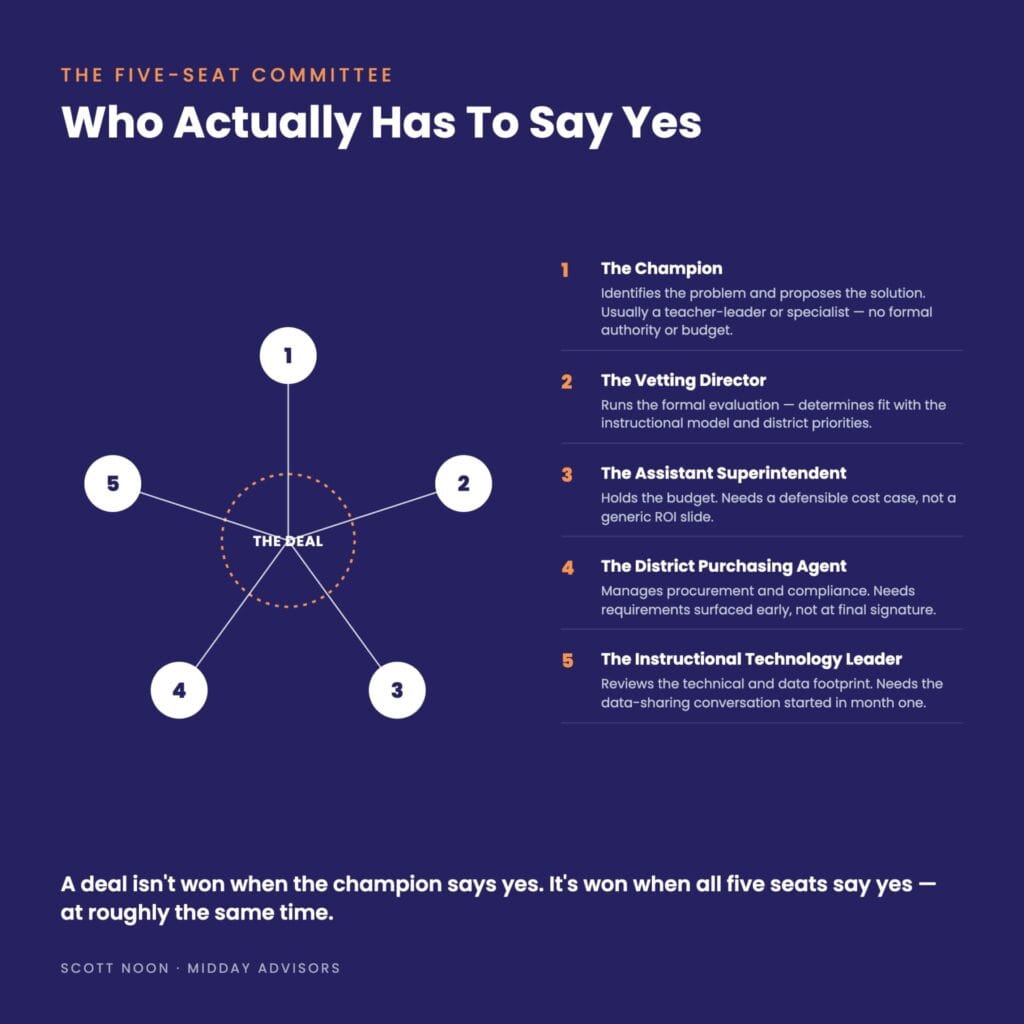
    A typical K-12 buying committee has five seats: the champion who identified the problem and proposed the solution, the director-level staffer who formally vets the product and establishes it as a funded priority, the assistant superintendent who holds the budget, the district’s purchasing agent who manages procurement and compliance, and the instructional technology leader who reviews the product’s technical and data footprint. Call it the Five-Seat Committee.

    Missing any one seat doesn’t just slow a deal down. It creates a failure mode specific to that seat: a champion who’s excited but was never handed off to a director with the authority to prioritize the initiative, or a director who loves the product but never looped in the purchasing agent early enough to avoid a procurement delay that kills the timeline.

    The Champion: Identifies the Problem and Proposes the Solution

    The champion is usually the first real conversation, often a teacher-leader, coach, or specialist close to the classroom-level pain point the product solves. They rarely hold formal evaluation authority or budget, but they are the reason the opportunity exists at all. A rep who only ever talks to the champion mistakes enthusiasm for momentum, because the champion’s job ends the moment they’ve convinced someone with actual authority to look at it.

    The Vetting Director: Runs the Formal Evaluation

    This is the director-level district staffer, often a Director of Curriculum, Academic Programs, or Student Services, who takes the champion’s idea and puts it through a real evaluation: does it fit the instructional model, does it solve a problem the district has already prioritized, is there a case for funding it. This is the seat that turns an enthusiastic champion into an actual initiative with district backing, and it’s also the seat most reps skip past because it feels like a formality between the champion and the money.

    The Assistant Superintendent: Holds the Budget

    The assistant superintendent doesn’t need to be convinced the product works. They need a defensible case for why this specific line item survives their budget review against every other request competing for the same dollars, and they’re the one who has to answer for that decision internally. A deal that never reaches this seat with a real cost case often reappears the following year as a casualty of a budget cut nobody saw coming.

    The District Purchasing Agent: Manages Procurement

    Purchasing agents run the compliance side of the deal: RFP requirements, bid thresholds, contract terms, and whatever state purchasing law applies to a district’s size and funding source. A product that has full buy-in from the champion, the director, and the budget holder can still stall for months if the purchasing agent wasn’t looped in early enough to flag a procurement requirement that changes the entire timeline.

    The Instructional Technology Leader: Reviews the Technical Footprint

    Data privacy, integration with existing systems, and device requirements are this seat’s territory, and in K-12 that carries real compliance weight. A product that looks simple from a curriculum standpoint can stall for months over a data-sharing agreement nobody flagged early, which is why this review needs to start well before a contract reaches final signature.

    Winning all five seats gets a contract signed. It doesn’t guarantee the product survives to renewal, because the people actually using the product day to day, the teachers and practitioners, aren’t a formal seat on this committee even though their adoption decides whether the purchase was worth making. The two-buyer problem in K-12 covers that separate risk: winning the institutional buyer and losing the practitioner buyer produces a signed contract and a renewal loss.

    Why Do K-12 Deals Stall After the Champion Says Yes?

    K-12 deals stall after a champion signs on because the other four seats at the table were never actually engaged, so their requirements surface late, sequentially, and without warning, instead of being surfaced and resolved early in parallel. A rep who treats the champion’s enthusiasm as the whole deal is optimizing for the seat that’s easiest to win, not the seats that actually decide whether the contract gets signed.

    This is what multi-threading actually means in K-12: not talking to more people for its own sake, but deliberately engaging the vetting director, the budget holder, the purchasing agent, and the IT reviewer early enough that their requirements can be addressed before they become a reason the deal quietly stops moving.

    How to Work All Five Seats at Once

    Multi-threading a Five-Seat Committee starts with mapping it explicitly, by name, at the start of an opportunity, rather than discovering the purchasing agent exists after the vetting director has already gone quiet waiting on a procurement answer. For each seat, a rep needs an answer to one question: what does this specific person need to be true in order to say yes, or to stop blocking.

    For the vetting director, that usually means helping them build the internal case that this solves a problem the district has already named as a priority. For the assistant superintendent, it means a cost case framed in terms their budget cycle already recognizes, not a generic ROI slide. For the purchasing agent, it means surfacing procurement requirements in the first conversation, not the final week before signature. For the instructional technology leader, it means bringing the data-sharing and integration conversation forward to the first month of the relationship rather than treating it as a late-stage formality.

    None of this replaces the work marketing does before a rep is ever assigned to the account. A district that already recognizes a company’s name from a peer referral or a conference conversation gives a rep a warmer starting point with every one of the five seats, not just the champion. But once the account is assigned, working it well means treating all five seats as the actual deal, not the champion as a proxy for the other four.

    A K-12 deal isn’t won when the champion says yes. It’s won when the vetting director, the budget holder, the purchasing agent, and the IT reviewer all have a reason to say yes too, at roughly the same time, and none of them find out about the decision after it’s already been made.

    If your organization is dealing with a version of this, let’s talk.

    Scott Noon is the founder of Midday Advisors, a K-12 go-to-market advisory firm that works with education companies and non-profits.

    Frequently Asked Questions

    Who is typically on a K-12 buying committee?

    Five roles most often decide a K-12 purchase: the champion who identifies the problem and proposes the solution, the director-level staffer who formally vets it and sets it as a priority, the assistant superintendent who holds the budget, the district’s purchasing agent who manages procurement and compliance, and the instructional technology leader who reviews the technical and data footprint.

    What does multi-threading mean in a K-12 sales context?

    Multi-threading means deliberately engaging every stakeholder on the buying committee early in the sales process, rather than relying on a single champion to represent everyone else’s requirements. It surfaces procurement, budget, and technical requirements early enough to resolve them instead of losing the deal to them late.

    Why does a deal stall even after the champion is fully on board?

    Because the champion is one of five seats, and the other four, the vetting director, the assistant superintendent, the purchasing agent, and the instructional technology leader, often haven’t been engaged. Their requirements surface later in the process, and by then they read as new obstacles rather than manageable early-stage questions.

    What’s the difference between the champion and the vetting director?

    The champion identifies the problem and proposes the solution, often from a classroom-level vantage point, but usually doesn’t hold formal evaluation authority or budget. The vetting director is the seat that runs the actual evaluation and establishes the initiative as a funded district priority. Treating the champion as if they were the vetting director is a common way deals stall.

    What’s the biggest stakeholder mistake education companies make?

    Waiting too long to loop in the purchasing agent and the instructional technology leader. Both seats can introduce procurement or technical requirements that change a deal’s timeline entirely, and surfacing those requirements late, after the champion and vetting director are already sold, is one of the most common ways a deal stalls right before signature.

  • What K-12 Demand Generation Actually Looks Like Before a Rep Ever Calls

    What K-12 Demand Generation Actually Looks Like Before a Rep Ever Calls

    Every K-12 company agrees that marketing should create demand before sales makes contact. Almost none of them can describe what that actually looks like week to week. K-12 demand generation gets treated as a strategy slide instead of a set of repeatable motions, which is exactly why the job keeps sliding onto a rep’s calendar by default.

    That gap is the subject of Why Cold Prospecting Is a Marketing Job, Not a Sales Job, in K-12, which introduced the Empty-Funnel Test: a rep’s calendar full of first conversations with strangers means the marketing function is empty. This post is the answer to the question that piece leaves open. If cold outreach isn’t how a district is supposed to first hear a company’s name, what is?

    What Does K-12 Demand Generation Actually Involve?

    K-12 demand generation is the set of activities that make a district recognize a company’s name before a rep ever reaches out, so the first call is a return visit instead of a cold approach. In practice, that comes down to three repeatable signals: content the district’s leaders actually read, a referral or peer mention that reaches them secondhand, and visibility at the events where they already gather. Call it the Three Warm Signals framework.

    None of the three signals require a large team or a big budget. They require a company that treats recognition as something built on purpose, on a cadence, months ahead of any specific sales conversation.

    The First Warm Signal: Content Practitioners Actually Read

    Most K-12 content is written for a search engine, not a curriculum director. It’s generic, keyword-stuffed, and forgettable the moment it’s read. The content that actually creates a warm signal is specific enough that a practitioner recognizes their own district in it: a breakdown of a funding mechanism unique to their state, a framework for a decision they’re actually making this quarter, an honest account of what implementation looked like at a comparable district.

    That specificity is what makes content shareable inside a district’s own network. A curriculum director doesn’t forward a generic guide to a peer at the next district over. They forward the piece that named their exact problem.

    The Second Warm Signal: A Referral or Peer Mention

    K-12 buyers trust peers over vendors by a wide margin, and a referral does something a cold call structurally cannot: it arrives with someone else’s credibility already attached. This is why a company’s best-fit early customers are worth more as a referral network than as a case study logo. A single satisfied curriculum director willing to take an unsolicited call from a peer at another district produces more usable pipeline than a month of cold dialing.

    Building this signal on purpose means asking for the introduction directly, not hoping it happens organically. Most companies wait for referrals to volunteer themselves. The ones with a real demand-generation motion ask for them as a matter of process, after every successful renewal and every strong pilot result.

    The Third Warm Signal: Visibility Where Districts Already Gather

    State ed-tech conferences, regional superintendent associations, and curriculum-specific convenings are where K-12 leaders already spend their scarce professional-development time. Showing up consistently, not once, at the same two or three gatherings a target segment of districts actually attends does more to build recognition than a first-time appearance at ten different events.

    Consistency is the mechanism here. A name a curriculum director has seen at the same regional conference three years running reads as an established player. A name they saw once, at an event they don’t remember choosing to attend, reads as noise.

    Why Doesn’t Cold Outreach Build Real K-12 Pipeline?

    Cold outreach doesn’t build real pipeline in K-12 because the buying process is relationship-driven and multi-stakeholder in a way that a first cold call cannot shortcut. A typical K-12 purchase runs close to nine months from first conversation to signature and involves five to seven people who all have to agree, which means the first interaction a district has with a company matters far more than it would in a transactional, single-buyer sale.

    When that first interaction is a cold call from someone the district has never heard of, it gets filed exactly where it belongs: as noise to screen out. When it’s a follow-up to a name the district already recognizes from a peer, a piece of content, or a conference conversation, it gets treated as a return visit worth taking. The three warm signals exist to make sure the first interaction is the second kind, not the first.

    Building the Three Warm Signals Into a Repeatable Motion

    The mistake most companies make isn’t skipping these activities entirely. It’s treating them as occasional and disconnected: a blog post here, a conference booth there, a referral that happened to come in. A real demand-generation motion runs all three signals on a defined cadence and tracks which districts have actually been exposed to which signal before a rep is ever assigned to call them.

    That means a content calendar built around real practitioner problems instead of generic keyword targets, a standing process for asking satisfied customers for introductions rather than waiting for volunteers, and a short list of conferences a company commits to for multiple years rather than sampling broadly. It also means giving reps a list of districts that have already received at least one warm signal, instead of a spreadsheet of every district in a state.

    Companies without a marketing team yet don’t need to build all of this in-house immediately. Buying the function at the size a company can actually use, through a fractional CMO or a K-12 fluent agency, is often the fastest way to get these three signals running before a rep’s calendar fills up with cold strangers. Midday Advisors’ fractional CMO work is built around exactly this: standing up the demand-generation motion before a sales hire has to compensate for its absence.

    Demand generation in K-12 isn’t a slide. It’s three signals, run on purpose, months before a rep ever needs a name to call.

    If your organization is dealing with a version of this, let’s talk.

    Scott Noon is the founder of Midday Advisors, a K-12 go-to-market advisory firm that works with education companies and non-profits.

    Frequently Asked Questions

    What is K-12 demand generation?

    K-12 demand generation is the set of marketing activities, content, referrals, and event visibility, that make a district recognize a company’s name before a sales rep ever makes contact. Its purpose is to turn a cold call into a warm follow-up.

    What are the three warm signals in K-12 demand generation?

    Content specific enough that a practitioner recognizes their own district in it, a referral or peer mention that carries someone else’s credibility, and consistent visibility at the events where target districts already gather. Together they make a district’s first real interaction with a company feel like a return visit instead of a cold approach.

    Why is a referral more valuable than a cold call in K-12 sales?

    A referral arrives with a peer’s credibility already attached, which matters enormously in a market where district buyers trust other practitioners over vendors. A cold call has to earn that trust from zero, inside a single conversation, which rarely works.

    How do we build demand generation if we don’t have a marketing team yet?

    Buy the function at the size you can use. A fractional CMO or an agency experienced in K-12 can build and run the three warm signals, content, referrals, and event presence, so a sales hire isn’t left compensating for a marketing function that doesn’t exist yet.

    How is this different from just doing more content marketing?

    Content is only one of the three signals. Content without a referral motion or consistent event presence still leaves a district unaware of a company by name. The three signals work together because each one reaches a different part of how K-12 buyers actually build trust.