Category: Blog

  • Why Cold Prospecting Is a Marketing Job, Not a Sales Job, in K-12

    Cold prospecting is not a sales activity. It’s a marketing activity that a lot of K-12 companies have quietly handed to the wrong person on the team, and it’s costing them the year.

    Here’s the pattern behind most failed K-12 sales prospecting: a founder-led education company with eight or ten people, one or two reps carrying a number, and thin pipeline. The instruction that comes down is always the same. Prospect harder. Build the list. Work the list. Spend the morning calling districts that have never heard the company’s name.

    Everyone nods, because that is what salespeople are supposed to do. But look at what the company has actually built. Its most expensive, most relationship-skilled person is spending half the week on the one task that requires none of that skill: making a list of strangers. The work that does require judgment, getting inside a district, finding the champion, mapping the committee, keeping five stakeholders warm across a nine-month cycle, gets whatever time is left over.

    That is backwards, and in K-12 it is backwards in a way that costs an entire budget cycle.

    Why Do K-12 Companies Make Reps Prospect Cold?

    K-12 companies make reps prospect cold because no one has built the function that should be doing it instead. Marketing is supposed to create demand before a rep ever dials. When that function doesn’t exist, the company closes the gap the only way it can: by asking the salesperson to manufacture recognition one call at a time.

    This shows up in a few predictable ways. A founder who closed the first five deals personally keeps running sales the same way at fifteen people, now with a rep attached to the same undifferentiated list. A Series A edtech company hires its first quota-carrying rep before it has a single piece of content, a case study, or a conference presence, so the rep spends the fall cold-calling districts that have never heard the name. A nonprofit expanding into new states assumes its mission will carry recognition across state lines, and hands the state lead a spreadsheet of every district instead of a shortlist of ones that already know the organization.

    In every version, the company has confused activity with strategy. A rep dialing a list looks like sales is happening. It isn’t. It’s marketing, performed badly, by someone who was hired to do something else.

    Why Does Marketing Get Built Last in K-12 Companies?

    Marketing gets built last because sales feels urgent in a way marketing doesn’t. A rep has a number attached to their name and a monthly rhythm the whole company can see. Marketing looks like overhead you’ll fund once things are working, so it gets deferred until the pipeline problem is already expensive.

    The feedback loop hides the cost. A rep can prospect cold all fall, book a handful of “send me more information” calls, and look productive the entire time. Nobody finds out the motion failed until the district budget cycle closes in spring and the pipeline those calls were supposed to produce isn’t there. By then the company has spent a full rep-year discovering that its salesperson has been an expensive substitute for a marketing function it never built.

    This is the reason the split between demand creation and account ownership matters more in K-12 than in most markets. A typical K-12 purchase involves five to seven stakeholders, a curriculum director, a superintendent, a CFO, an IT lead, and often the teachers piloting the product, all of whom have to agree before a contract gets signed, across a buying cycle that commonly runs nine months from first conversation to signature. No email sequence navigates that. It takes a person who can read the politics of a specific district and hold trust across a committee. Spending that person’s time on cold outreach instead is not a minor inefficiency. It is the difference between a closed year and an empty one.

    What to Do Instead: Split Demand Creation From Account Ownership

    Creating demand belongs to marketing. That means building the list of districts that should know the company, getting the name in front of them before a rep ever dials, and doing it through content, conference presence, webinars, referrals, and the kind of visibility that turns a cold district into a warm one. This is a systems job. It scales, and it runs in the background whether or not a rep is currently making calls.

    Working an account belongs to sales. Not finding the account. Working it: multi-threading into a named district, building relationships that survive a nine-month cycle, and being the human in the room full of humans who all have to agree to trust the company. Point the rep at specific accounts a district engagement strategy has already surfaced, never at a blank list.

    Not having a marketing team yet doesn’t mean the rep should absorb the job. It means buying the function at the size the company can actually use. A fractional CMO or an experienced agency can build the strategy and run the tactics that turn a cold market into a list of warm prospects, so the rep spends hours on districts that already recognize the name instead of manufacturing recognition one call at a time. Midday Advisors’ fractional CMO work exists for exactly this gap: education companies that need the marketing function built before the sales function can work.

    Here’s a simple way to check which problem a company actually has. Call it the Empty-Funnel Test: look at a rep’s calendar for the week. If it is full of first conversations with people who have never heard of the company, that is not a sales problem. It is an empty marketing function, and the company’s most expensive person is standing in for it.

    Just as bad, the rep’s calendar is empty because nobody ever turned the districts that marketing warmed up into a list of named accounts to work. Marketing may have done its job, or it may not have, but either way, no one built the handoff so the rep has nothing assigned and nothing to do but wait. That’s not a rep who’s coasting. That’s a company that never built the connective tissue between creating demand and owning an account, and it’s now paying for both gaps in the same empty week.

    Cold prospecting into the void is not selling. It is what a company does instead of building the thing that would make selling possible, and the Empty-Funnel Test is the fastest way to tell which one is actually happening.

    Related reading: Why K-12 Sales Teams Ignore Marketing Leads — And What to Do About It, The Case Against Hiring a Full-Time CMO Before You Have a Strategy, and Why K-12 District Buyers Don’t Trust Vendors — And What Education Companies Should Do Instead.

    If your organization is dealing with a version of this, let’s talk.

    Scott Noon is the founder of Midday Advisors, a K-12 go-to-market advisory firm that works with education companies and non-profits.

    Frequently Asked Questions

    Is cold prospecting a marketing function or a sales function in K-12?

    It’s a marketing function. Marketing is responsible for building recognition with districts before a rep ever makes contact. When a company skips that step, it ends up asking a sales rep to do marketing’s job with none of marketing’s tools, which is why the results tend to disappoint.

    Why does K-12 sales pipeline look fine in the fall and then disappear by spring?

    Because “send me more information” calls from cold prospecting feel like progress but rarely convert. District budget cycles lock in the spring, so a company doesn’t find out the fall’s cold outreach failed to build real pipeline until the cycle closes and there’s nothing left to show for it.

    We can’t afford a full-time marketing hire yet. What should we do instead?

    Buy the function at the size you can use. A fractional CMO or a marketing agency familiar with K-12 can build and run the demand-generation strategy, so reps spend their time on districts that already recognize the company rather than cold-calling strangers.

    How many stakeholders are typically involved in a K-12 buying decision?

    Commonly five to seven: a curriculum director, a superintendent, a CFO, an IT lead, sometimes a board, and often the teachers running a pilot. All of them generally need to agree before a contract is signed, which is why account ownership requires a skilled human rather than an email sequence.

    What’s the fastest way to tell if a company has a sales problem or a marketing problem?

    Look at the rep’s calendar. If it’s full of first conversations with people who’ve never heard of the company, that’s the Empty-Funnel Test failing: not a sales problem, but an empty marketing function that the rep has been asked to fill.


  • The K-12 ICP Problem: You Know Who to Target. You Don’t Know How They Buy.

    The K-12 ICP Problem: You Know Who to Target. You Don’t Know How They Buy.

    Most ideal customer profile frameworks were built for B2B SaaS. Short sales cycles. Single decision-makers. K-12 companies imported those frameworks wholesale, and they’re misreading their own market as a result.

    A typical K-12 ICP describes a district. Enrollment size. Grades served. Funding type. Geography. Poverty index. It’s a firmographic portrait of the customer, and it’s incomplete in the way that matters most for closing deals.

    Knowing who your buyer is tells you which districts belong on the target list. It tells you nothing about how those districts actually buy. Not how long it takes. Not who’s in the room. Not when in the year any of it happens.

    Scott Noon of Midday Advisors calls this the ICP Gap: the distance between knowing your target and understanding your buyer. It’s the most common structural failure in K-12 go-to-market, and it explains a lot of the pipeline surprises, long cycles, and late-stage losses that teams can’t quite account for.

    What is a K-12 ideal customer profile?

    A K-12 ICP is a description of the district most likely to become a good, long-term customer. In most companies, it’s built from firmographic data: district size, grade configuration, Title I eligibility, region, student demographics, and sometimes prior tech adoption.

    This is useful. It tells you which districts are worth prospecting and which aren’t a fit on size or budget. What it doesn’t tell you is how a district that matches your profile actually makes a decision. That takes a different kind of profile.

    Why does a firmographic ICP fall short in K-12?

    Because K-12 buying works nothing like the B2B SaaS market the ICP framework was built for. In SaaS, firmographics and buying behavior line up. The buyer is often the decision-maker. Cycles run weeks to months. A good champion can move a deal.

    K-12 doesn’t work that way. Decisions are made by committees, not individuals. Budgets get set months before contracts are signed, on a fiscal calendar that doesn’t match the calendar year. A vendor relationship often has to exist twelve to eighteen months before a purchase is even possible. And board accountability, risk aversion, and memory of the last vendor shape the outcome in ways no firmographic profile captures.

    A company can target exactly the right district, reach the wrong person, at the wrong point in the cycle, with a message aimed at the wrong concern. The ICP was accurate. The read on how they buy was missing.

    What is the buying behavior map?

    The buying behavior map is the other half of the ICP. Where the firmographic profile answers “who,” the buying behavior map answers “how.” It has four parts.

    The stakeholder map. Who’s actually in the decision beyond your main contact? Most K-12 purchases involve a curriculum director, a data or assessment lead, a building-level voice, and someone from finance. Knowing who’s in the room, and who holds a quiet veto, changes how you sequence the relationship.

    The buying calendar. When does the window actually open? Most districts set budgets in the spring for the next school year. A vendor entering in October expecting a March contract is off by a year. Mapping the calendar tells you when to invest, not just where.

    The risk profile. What is the district managing when they evaluate you? K-12 procurement is a risk exercise more than a problem-solving one. Board optics, staff capacity, and the last vendor’s failure weigh more than a feature comparison. Name the two or three risks that decide the deal.

    The entry point analysis. Where can a new vendor actually get in and still win? For some categories, if you’re not in the conversation before the RFP is written, you’re already out. For others, a referral or a conference opens a late door. Knowing the real entry points keeps you from chasing decided deals.

    Why do companies skip the buying behavior map?

    Because the firmographic ICP is easy to see and the behavior map isn’t. You can put district size in a slide and filter a CRM by it. It produces a list that looks like a strategy. The behavior map doesn’t show up in Salesforce, so it goes unbuilt, and the real cause of slow conversion goes unexamined.

    The data isn’t missing. It’s sitting with your experienced account managers and regional directors, who have been in hundreds of district conversations. They know when budgets lock. They know who shows up in the final meeting. They know the objection that quietly kills deals. Most companies just never make that knowledge explicit, because the pressure is always on generating pipeline, not understanding why it converts.

    How do you build the buying behavior map?

    You don’t need a research budget. You need four to six structured conversations with people who’ve been in K-12 buying rooms and paid attention.

    Start with the buying calendar. For your top three or four segments, map when budget talks happen, when committees form, when RFPs go out, and the last real moment to enter and still influence the buy. Put it on an actual calendar. Most teams are surprised how narrow the window is.

    Then build the stakeholder map. Take a few recent closed-won deals and write down who was in every meeting. Who started it? Who had a veto nobody surfaced until late? Who was the unexpected advocate? A pattern emerges across three to five deals, and that becomes your template.

    Then write the risk map. For the deals that reached a final decision and lost, what was the district actually managing that your pitch never addressed? Most teams know the answer if they debrief honestly. Write it down and make it part of the message.

    This takes a few weeks, not months. It produces a one-page profile that sits next to your firmographic ICP and changes the whole motion: when you reach out, which conferences you work, what your messaging leads with, how you define pipeline stages.

    If your K-12 motion is producing long cycles and late-stage losses you can’t explain, the firmographic ICP probably isn’t the problem. The buying behavior map you haven’t built yet is.

    Learn more in the guide: How K-12 Districts Actually Buy.

    If your organization is dealing with a version of this, let’s talk. You can see how we work on our Services page.

    Scott Noon is the founder of Midday Advisors, a K-12 go-to-market advisory firm that works with education companies and nonprofits.

    Frequently Asked Questions About K-12 Ideal Customer Profiles

    What should a K-12 ideal customer profile include?

    A complete K-12 ICP includes two layers. The firmographic profile covers district size, grades served, funding type, geography, and demographics — describing which organizations are plausible customers. The buying behavior map covers the stakeholder committee structure, the buying calendar (when budgets lock and decisions are made), the risk profile (what the district is managing beyond the vendor’s feature set), and the realistic entry points for new vendor relationships. Most K-12 companies have only built the first layer.

    Why do K-12 sales cycles take so long?

    K-12 sales cycles are long because the buying process is committee-driven, budget-constrained by fiscal calendars that lock in spring, and risk-averse in ways that require extended relationship-building before a purchase is possible. Most districts need to see a vendor in multiple contexts — conference, peer referral, pilot — over twelve to eighteen months before a purchasing conversation is realistic. A company that enters a relationship in October expecting a contract by March is misreading the buying calendar by a full year.

    What is a buying behavior map?

    A buying behavior map is a documented profile of how a specific customer segment makes purchasing decisions. For K-12 companies, it typically captures: the stakeholder committee structure (who influences, approves, and can veto a purchase), the buying calendar (when budget conversations happen and when the window for new vendors opens and closes), the risk profile (what concerns determine whether a vendor makes the final shortlist), and the entry point analysis (where in the process a new vendor can realistically enter and still win). It complements the firmographic ICP by answering “how” rather than “who.”

    How do you identify the real decision-maker in a K-12 sale?

    In most K-12 purchasing decisions, there isn’t a single decision-maker — there’s a committee. The contract signer is rarely the only person with meaningful influence. Curriculum directors, data coordinators, building-level leaders, and finance staff all participate in different phases of the evaluation. Identifying who holds veto authority (which often doesn’t surface until late in the process), who the internal advocate is likely to be, and who initiates evaluations in the first place gives a more accurate picture than focusing on the org chart contact. This mapping is most reliable when built from retrospective analysis of several closed-won deals.

    What’s the difference between ICP and buyer persona in K-12?

    The ICP describes the type of organization that is a strong fit (district-level firmographics). The buyer persona describes the individual within that organization — their role, priorities, and decision-making style. Both are necessary, but the most commonly missing piece in K-12 go-to-market strategy is neither — it’s the buying process map, which describes how the organization makes decisions regardless of which individual is in the room. Understanding the process is often more predictive of deal outcomes than understanding any single person’s persona.

  • Outcomes-Based Contracting in K-12: What EdTech and PD Vendors Need to Know

    Outcomes-Based Contracting in K-12: What EdTech and PD Vendors Need to Know

    Districts are done paying for tools that don’t work. The question now is whether the accountability model they’re building measures the right things.

    Outcomes-based contracting is growing fast. It ties part of a vendor’s payment to hitting agreed student or program outcomes. As of 2025, the Center for Outcomes Based Contracting had supported 46 completed contracts. In 2021, the number was five. This isn’t a trend anymore. It’s becoming infrastructure.

    If you lead sales or marketing at an edtech company, you’ve likely seen OBC language in RFPs already. If you run a professional development company, you may not have yet. But it’s coming. And the version headed your way is harder to navigate than what edtech vendors face.

    Here’s the model, where it stands, and what to do about it.

    What is outcomes-based contracting in K-12?

    Outcomes-based contracting (OBC) is a procurement model where part of a vendor’s payment, usually at least 40 percent, depends on hitting pre-agreed outcomes. The contract names shared goals, sets metrics, and builds in a review process both sides run together.

    This is a real break from how K-12 buying used to work. A traditional contract is a service agreement. The vendor delivers something, the district pays, and results get measured later, if at all. OBC flips that. The vendor now has skin in the game until the outcomes actually land.

    The model was built and scaled mostly by the Center for Outcomes Based Contracting at the Southern Education Foundation. Harvard’s Center for Education Policy Research ran a parallel effort on math tutoring. Both started with high-dosage tutoring. The intervention is discrete, and the outcome is measurable enough to hold a contract together.

    How is outcomes-based contracting working in edtech?

    Better than most vendors expected, but with a lower hit rate than the headlines suggest. Among the 46 completed contracts, 56 percent of contracted outcomes were achieved. That’s up from 50 percent in the earlier group. It also means nearly half the time, outcomes weren’t fully met and vendors weren’t fully paid.

    That’s not the model failing. That’s the model working as designed. You need to understand that number before you sign one.

    The upside shows up in usage. Students in OBC pilots hit their recommended dosage 69 percent of the time. The industry baseline is about 5 percent. When districts have money riding on the outcome, they show up differently.

    The examples make it concrete. In Ector County, Texas, the district signed a $12 million deal with several tutoring vendors. The ones whose tools produced results got paid in full. The ones that underperformed did not. In Fresno Unified, a contract for the i-Ready reading tool required weekly cross-team meetings all year. When some outcomes fell short, Fresno didn’t pay the full amount. That wasn’t a dispute. That was the contract doing its job.

    The hard part is time and data. OBC negotiations run about two and a half months. Districts need reliable outcome data, and most don’t have it at the level OBC requires. And teachers need to use the tool with fidelity for any of it to work. Classroom-level variance is the most common reason a contract underperforms.

    Why are districts moving toward outcomes-based contracts?

    Districts are under budget pressure they haven’t felt in years. Federal relief money ended, and spending habits haven’t caught up. Meanwhile, years of edtech spending produced, in the words of a Digital Promise report, “billions of dollars invested with little to no return for learner outcomes.”

    OBC is the structural answer. It doesn’t ask districts to get better at judging vendor claims upfront. It builds a mechanism that ties vendor pay to district outcomes over the life of the deal. For a procurement director defending every dollar, that’s a compelling shift.

    The support behind it is real. The Southern Education Foundation, Digital Promise, and Harvard CEPR are all invested in scaling it. Arkansas ran a full state cohort. California is launching one of up to 10 districts. This is no longer an experiment.

    Why is outcomes-based contracting harder for PD providers?

    Because the chain from professional development to student outcomes runs through too many things the vendor can’t control. In edtech tutoring, the link is short. A student uses a tool, usage is tracked, and a benchmark moves within the year. The attribution is tight enough to build a contract around.

    PD doesn’t work that way. Scott Noon of Midday Advisors calls the problem the Attribution Ladder. The vendor trains teachers. Teachers change their practice. Students get different instruction over time. Outcomes improve. Every rung adds noise the vendor never controls.

    Did the district protect time for implementation? Did the principal reinforce the new practice? Did staff turnover break the cohort mid-year? Did a separate curriculum adoption pull teachers in another direction? All of this happens routinely. None of it is the PD vendor’s fault. But in an outcomes contract, the vendor absorbs the risk for all of it.

    This matters now. Survey data shows 17 percent of district leaders plan to use OBC for professional development. That’s higher than the 12 percent planning to use it for tutoring. The appetite is real. The clarity about what to measure is not.

    What should PD providers do to get ahead of OBC?

    Define the measurement framework before the district does. Don’t resist the trend. Resistance reads as a vendor who doesn’t believe in their own product. Instead, come with leading indicators of teacher practice change, measurable inside a contract term and attributable to you.

    A few hold up under scrutiny. Implementation fidelity scores, measured through structured classroom walkthroughs at 30, 60, and 90 days. Coaching completion, paired with a lesson artifact that shows the coaching was applied. Pre and post observation scores, using a rubric tied to your program, not the district’s generic evaluation form.

    Then structure the payment as graduated, not all-or-nothing. One threshold of documented practice change triggers partial payment. A higher one triggers full payment. And pair your obligations with the district’s: adequate teacher time, administrator participation, data sharing. If the district doesn’t hold up its end, your outcome commitment adjusts.

    This isn’t defensive. It’s a sales asset. A PD vendor who walks in with an accountability framework is having a different conversation than one who hedges. The first is a partner. The second is hoping the question goes away.

    The districts pressing for accountability aren’t wrong. The work now is making sure the accountability they build measures what your program actually produces, not just what’s easy to count.

    If your organization is navigating outcomes-based contracting, let’s talk. You can see how Midday Advisors helps education companies on our Services page.

    Scott Noon is the founder of Midday Advisors, a K-12 go-to-market advisory firm that works with education companies and nonprofits.

    Frequently Asked Questions About Outcomes-Based Contracting in K-12

    What is outcomes-based contracting in K-12 education?

    Outcomes-based contracting (OBC) is a procurement model in which at least 40 percent of a vendor’s payment is tied to achieving pre-agreed student or program outcomes, rather than to service delivery alone. The contract defines mutual goals, measurable metrics, and a continuous improvement process. It was developed and scaled primarily by the Southern Education Foundation’s Center for Outcomes Based Contracting, which has supported 46 completed contracts nationwide since 2021.

    Which districts are using outcomes-based contracts with vendors?

    Districts that have implemented OBC include Duval County (FL), Ector County (TX), Fresno Unified (CA), Denver Public Schools, Fulton County (GA), Albuquerque Public Schools, Richmond Public Schools (VA), Santa Ana Unified (CA), Jackson Public Schools (MS), and multiple Arkansas districts in a 2025-26 state cohort. California is launching a new cohort of up to 10 districts in October 2026.

    Do outcomes-based contracts actually work?

    The data is mixed but improving. Among contracts tracked by the Center for OBC, 56 percent of contracted outcomes were fully achieved as of 2025, up from 50 percent in the earlier cohort. Students in OBC programs met recommended usage dosage at 69 percent, compared to an industry baseline of approximately 5 percent. The model significantly improves implementation fidelity, though nearly half of contracts don’t fully hit outcome targets.

    Can outcomes-based contracting work for professional development vendors?

    Not with the same metrics used in edtech OBC. The student outcome metrics that work in tutoring contracts don’t translate cleanly to PD because the attribution chain (from vendor program to teacher practice change to student outcomes) runs through too many variables outside the vendor’s control. PD-focused OBC requires a different framework built around leading indicators of teacher practice change, including implementation fidelity scores, coaching completion with evidence of application, and pre/post observation data tied to program-specific rubrics.

    What should an edtech or PD vendor do when a district raises outcomes-based contracting?

    Lead with a proposed framework rather than a hedge. Define the metrics you’re willing to be held to, specify the district conditions required for measurement to be valid, and propose a graduated payment structure that reflects shared risk. Vendors who arrive at that conversation with a prepared accountability framework are positioned as partners. Those who deflect are signaling that they don’t believe in their own results.

  • Innovation Strategy for Education Organizations: What It Actually Takes

    Innovation Strategy for Education Organizations: What It Actually Takes

    “Innovation” is the most expensive word in K-12 sales. Not because it costs money to say. Because it costs credibility every time it lands without evidence behind it.

    Walk the floor of any education conference and count the organizations calling themselves innovative. The number is high. The number that can explain what that means for a district buyer with a real problem is much lower.

    That gap is where education companies lose ground. Not because the work isn’t interesting. Because they never built a clear approach to what innovation means, who it’s for, and how it shows up when it matters. Scott Noon of Midday Advisors calls it the Innovation Claim Gap: the distance between how you describe yourself inside the building and what a buyer actually experiences in the market.

    Innovation strategy isn’t design-thinking workshops or an ideation pipeline. It’s deciding what you’re promising buyers, and making sure you can deliver it consistently enough to survive a 12-month sales cycle, a committee review, and a renewal two years out.

    What does innovation strategy actually mean for education organizations?

    It’s a set of deliberate choices: where you focus your creative energy, how you turn it into buyer value, and how you communicate that value in a crowded market. For education companies, one reality shapes all three. K-12 buyers are skeptical.

    Procurement committees have seen dozens of vendors and sat through pitches that didn’t deliver. When you say “innovative,” many of them hear “unproven.” An effective strategy accounts for that. It doesn’t drop the claim. It builds the evidence that makes the claim credible.

    That means three things. Tie innovation to a specific buyer problem, not your own capability. Put proof next to the claim, so the buyer doesn’t have to hunt for it. And be specific about what’s new, for whom, and why it matters. “Innovative” on its own does interpretive work it can’t carry.

    Why do education companies struggle to turn innovation into an advantage?

    Because they build the innovation inside the company before they build the language for it outside. The Innovation Claim Gap opens for structural reasons, not personal ones.

    Most companies develop something new in product, curriculum, or service delivery first. By the time it reaches a sales conversation, the seller is describing internal capability instead of buyer outcome. The pitch is about what the company built, not what the buyer gets. That’s just how product-led teams work. The product team builds. Marketing describes the build. Sales repeats the description. Somewhere in there, the buyer’s real question goes unanswered: will this work for my schools, my teachers, my budget, my timeline?

    This is the same failure behind leading with product. An innovation claim built around your identity, not the buyer’s outcome, gets filed as noise. And in K-12 it compounds. Committees of three to seven people evaluate you on evidence of past results, not novelty. A claim with no proof structure doesn’t stand out. It raises questions. The average cycle runs nine to eighteen months, so a claim that can’t hold up across that timeline isn’t doing its job.

    What does an effective innovation strategy look like in practice?

    It starts with a choice most organizations avoid: deciding what you are not doing. Innovation is credible when it’s bounded. “We run professional development differently, and here’s exactly how” is a claim a buyer can test. “We’re an innovative education company” is a claim they can’t engage at all.

    From there, three moves make it work.

    Connect innovation to a named buyer problem. Not “we use AI to personalize instruction.” Instead: “curriculum directors tell us they spend most of their PD budget on sessions teachers can’t apply, so we built our system to fix that.” The closer the claim sits to a problem the buyer already feels, the less work they do to see why it matters. This is what being built for the K-12 market looks like in practice.

    Build a proof structure that travels with the claim. Put outcome data, implementation stories, and customer voices right next to the innovation narrative, not buried in a resource library. In a committee, the skeptic often decides whether the proof held. Make it easy for that person to say yes.

    Sustain the story across the whole cycle. A K-12 deal doesn’t close on the first call. The innovation story has to hold at the booth, the demo, the proposal, the committee, and the renewal. Treat innovation as a campaign line and your differentiation erodes as buyers spend more time with you. Build it into every layer, and each step confirms the claim instead of contradicting it.

    This is the work that separates companies that talk about innovation from those that build an advantage out of it. It’s not a creative problem. It’s a strategic and operational one, and it takes the same rigor as product development. If you’re weighing a senior marketing hire to lead it, read the case against hiring a full-time CMO before you have a strategy first.

    The companies that get this right don’t stop calling themselves innovative. They just make sure every buyer who hears the word immediately gets the answer to the question they didn’t ask out loud: prove it.

    Learn more in the Guide: Why K-12 Marketing Stalls, and What Actually Fixes It.

    If your innovation story isn’t converting, or you can’t say what makes you different in terms a district buyer would believe, that’s worth looking at directly. Let’s talk. You can also see how we work on our Services page.

    Scott Noon is the founder of Midday Advisors, a K-12 go-to-market advisory firm that works with education companies and nonprofits.

    Frequently Asked Questions

    What is an innovation strategy for an education organization?

    An innovation strategy is a set of deliberate choices about where an education company or nonprofit focuses its creative energy, how it translates that into buyer value, and how it communicates that value in the K-12 market. It’s not about generating new ideas — it’s about connecting those ideas to specific buyer problems and building the proof structure that makes the claim credible to skeptical procurement committees.

    Why don’t innovation claims work in K-12 sales?

    K-12 procurement committees evaluate vendors on evidence of prior results, not novelty. When an education organization claims to be innovative without a specific, evidence-backed context, buyers — who have heard the same claim from dozens of vendors — experience it as a signal of unproven value rather than differentiation. The claim needs a proof structure to land.

    How long is a typical K-12 sales cycle, and what does that mean for innovation messaging?

    Most K-12 sales cycles run nine to eighteen months from first contact to a signed contract. That timeline spans multiple stakeholders, evaluation stages, and budget conversations, which means innovation messaging needs to hold up consistently across every touchpoint — not just make a strong impression at a conference or on a first call.

    What is the Innovation Claim Gap?

    The Innovation Claim Gap is the distance between how an education organization describes itself internally — as creative, forward-thinking, and differentiated — and what a K-12 buyer actually experiences in the market. It opens when organizations develop innovation inside the product or program before developing the language and evidence structure to communicate it to buyers.

    How does Midday Advisors help education organizations with innovation strategy?

    Scott Noon works with education companies and nonprofits to develop go-to-market strategies that translate what they’ve built into language and proof structures that K-12 buyers find credible. That includes messaging, positioning, proof architecture, and sales cycle strategy — built for the way K-12 actually buys, not how B2B theory says it should work. Learn more about working with Midday Advisors.

    Scott Noon is the founder of Midday Advisors, a K-12 go-to-market advisory firm. He has spent 30+ years helping education companies and nonprofits build marketing and revenue strategies that work inside the K-12 market.

  • Why Your MQL Definition is Breaking Your Sales and Marketing Alignment

    Why Your MQL Definition is Breaking Your Sales and Marketing Alignment

    Most education companies and non-profits don’t have a lead generation problem. They have a definition problem — and it’s costing them every quarter.

    Marketing is hitting the number. Sales is ignoring the leads. And leadership is stuck in the middle, trying to referee a disagreement that both sides are right about.

    The culprit is almost always the same: an MQL definition built around activity instead of intent. And until you change the definition, you can’t fix the pipeline.

    What an Activity-Based MQL Actually Measures

    An MQL, a marketing qualified lead, is supposed to identify a buyer who is ready for a sales conversation. In practice, most MQL definitions identify something else entirely: a contact who has interacted with your content.

    Downloaded a resource guide. Attended a webinar. Opened three emails in a row. Visited the pricing page.

    Each of those signals can indicate interest. None of them, on their own, predicts a real conversation.

    I’ve asked revenue leaders across education companies to walk me through their MQL definition. What I hear, consistently, is a list of behaviors weighted by point value — ten points for a webinar registration, five points for a white paper download, twenty points if they visited the demo page twice. Hit a threshold and the contact gets flagged as marketing qualified and handed to sales.

    The problem isn’t the mechanics. The problem is what those signals actually represent.

    Attending a webinar means someone had forty-five minutes and found the topic interesting. Downloading a resource guide means they wanted the information. Neither of those things means they are in a buying process — or that they have the authority, budget, or urgency to become a customer.

    When sales receives a lead built on this logic, they often already know what it is before they dial. And when the first five MQLs this quarter turn out to be a curriculum coordinator who wanted the research, a graduate student writing a paper, and a competitor doing reconnaissance, the trust between sales and marketing degrades fast.

    Why Does This Keep Happening at Education Organizations?

    The activity-based MQL persists because it produces a metric that appears to show progress.

    Marketing can point to lead volume. The dashboard shows movement. Executives who ask “are we generating enough pipeline?” get an answer that reads like yes. The friction only becomes visible downstream when sales conversion rates remain flat or decline despite an apparently healthy top of the funnel.

    There is also a data availability problem specific to K-12 selling. Most K-12 procurement decisions are not made by the contact who downloads your white paper. A curriculum director might engage with your content for months before a decision ever surfaces. The superintendent, the CFO, and the board have to be in the room eventually — and none of them are on your email list.

    Most K-12 districts finalize purchasing decisions in the spring budget cycle, which means vendor relationships need to be established six to twelve months before a contract is ever signed. Activity-based MQL systems, which optimize for short-cycle conversion signals, are structurally misaligned with this reality. They measure the part of the buyer journey that is visible to a marketing automation platform and treat that as a proxy for the whole thing.

    The result is a scoring model that rewards the wrong behavior — and a sales team that learns, over time, not to trust the leads it receives.

    What a Behavior-Based MQL Definition Looks Like

    The shift from activity-based to behavior-based MQL qualification starts with one question: What buyer behavior has actually predicted a real conversation in the past?

    Not what happened before someone downloaded a guide. What happened before someone became a customer?

    We have worked through this exercise with education companies and non-profits across different market segments. The pattern is consistent. The signals that actually predict pipeline aren’t single-event actions — they are sequences, roles, and combinations.

    A contact who visits your pricing page once means little. A contact who visits your pricing page, then downloads your implementation guide, then requests a case study within the same week — that is a different kind of signal. It suggests active evaluation, not passive interest.

    Role matters as much as behavior. A content download from a district-level instructional leader at a 10,000-student district who has never engaged with you before is different from the same download by a building-level coach at a district you’ve already sold to. Your MQL definition should treat them differently.

    Timing in the procurement cycle matters. Many districts send out RFI requests in January and February, hold budget conversations in March and April, and make final decisions in May. A contact who begins engaging heavily in January may be on a buying timeline that an activity-based system — which scores any engagement equally — will miss entirely.

    Building a behavior-based MQL definition requires sales and marketing to do one thing they rarely do: sit down together and review the last twelve to twenty-four months of closed-won deals, work backward, and identify what the buyer actually did before they were ready to talk. That conversation is uncomfortable because it often reveals that marketing has been measuring the wrong things. But it’s the only way to build a scoring model that sales will trust.

    The Framework: Intent Signals vs. Engagement Signals

    A useful distinction that helps education organizations rebuild their MQL definition is the difference between engagement signals and intent signals.

    Engagement signals tell you that someone is aware of and interested in your content. Downloads, opens, webinar attendance, social follows. These are valuable for audience building and brand awareness. They are not reliable predictors of buying behavior.

    Intent signals tell you that someone is actively evaluating a solution. Pricing page visits, demo requests, case study downloads, return visits within a compressed time window, inbound questions that reveal a specific implementation timeline or budget cycle.

    A lead that shows only engagement signals is a nurture candidate. A lead that shows intent signals — especially in combination, and especially from a contact whose role and organization fit your ICP — is an MQL worth the sales team’s time.

    Most education companies and non-profits have the data to make this distinction. They just haven’t organized their scoring model around it.

    What Happens When You Fix It

    When sales and marketing agree on what buyer behavior actually predicts a conversation, two things change quickly.

    Lead volume goes down. This is not a failure — it’s the system working. Fewer leads that actually convert is better than more leads that don’t. Sales teams that spend their time on real buyers close more, and the feedback loop between marketing and sales starts to function.

    Trust comes back. Sales starts sharing what they hear in discovery. Marketing starts understanding what messaging is landing. The two functions stop operating as adversaries and start operating as a system.

    The MQL conversation is not really about marketing. It’s about whether your revenue organization has a shared definition of what a buyer looks like — and whether the tools you’re using to identify buyers are actually measuring the right things.

    Activity is easy to measure. Intent is harder. But intent is what closes deals.

    Learn more at K-12 Sales and Marketing Alignment: Why It Breaks and How to Fix It.

    If your sales and marketing teams can’t agree on what a qualified lead looks like — or if your pipeline looks healthy on paper but doesn’t convert — that’s a solvable problem. Let’s talk.

    Scott Noon is the founder of Midday Advisors, a K-12 go-to-market advisory firm that works with education companies and non-profits.

    Frequently Asked Questions

    What is an MQL in the context of an education company’s sales?

    An MQL (marketing qualified lead) is a contact that marketing has determined is ready for a sales conversation, based on their behavior and fit. At most education companies and non-profits, MQL definitions measure content engagement rather than actual buying intent, which leads to leads that sales doesn’t trust.

    Why do sales and marketing teams at education organizations disagree about lead quality?

    Usually because they are using different definitions of “qualified.” Marketing is measuring activity — downloads, opens, event attendance. Sales is measuring intent — does this person have a real problem, a budget, and authority to buy? Until both teams agree on what behavior actually predicts a sales conversation, the disagreement will persist.

    What signals actually indicate buying intent in K-12 sales?

    Combinations matter more than single events. A contact who visits your pricing page, downloads your implementation guide, and returns within the same week is showing a different kind of signal than someone who attended one webinar. Role and organization fit also matter — a district-level decision-maker engaging with evaluation content is a different MQL than a building-level practitioner with the same download history.

    How long does K-12 procurement typically take?

    Most K-12 districts finalize purchasing decisions in the spring budget cycle, which means vendor relationships need to be established six to twelve months before a contract is signed. MQL definitions borrowed from faster sales cycles often don’t account for this timeline.

    How do we rebuild our MQL definition?

    Start with your closed-won deals from the last twelve to twenty-four months. Work backward with your sales team to identify what the buyer actually did before they were ready to talk. What pages did they visit? What content did they request? What was their role and organization size? Build your scoring model around what actually predicted a conversation — not what was easy to track.

  • Why K-12 Sales Pipeline Reviews Produce False Confidence (And What to Track Instead)

    Why K-12 Sales Pipeline Reviews Produce False Confidence (And What to Track Instead)

    Your sales team has thirty active deals in the pipeline. Eight are in “advanced stages.” Two are closing this month. The forecast says the quarter will hit target.

    Then month ends, and the two deals slip. The eight don’t move. You hit 60% of goal.

    This isn’t a sales execution problem. This is a pipeline measurement problem — and it’s built into how most sales organizations think about K-12 deals.

    The issue isn’t that your team is pessimistic or your forecast is wrong. The issue is that your tools and stage definitions were designed for a different kind of sale entirely.

    Why Standard Sales Stages Don’t Map to K-12 Buying

    Most CRM systems and sales methodologies were built for SaaS. Fast cycle times. Individual buyers or small buying committees. Digital evidence of engagement. Contracts that move fast once a decision is made.

    K-12 works differently.

    A K-12 deal doesn’t move because a contact opened an email or attended a webinar. It moves because an assistant superintendent decided the district’s budget can support it, and that decision often happens months before any vendor conversation starts. It moves because the procurement officer found no red flags in compliance. It moves because three different buyer personas aligned around the same solution in the span of a single school year.

    Most sales teams track engagement signals — demo scheduled, proposal sent, meeting held. These are activity markers. In K-12, activity is a poor predictor of movement. You can have demo, proposal, and five meetings, and still be nowhere close to a decision if the institutional buyers haven’t aligned yet.

    Why does a K-12 deal slip?

    • The superintendent changed district priorities in the June board meeting.
    • The budget went to a different category.
    • The decision-maker went on maternity leave in July.
    • Your champion is a practitioner, but the institutional buyer never got comfortable with the price.
    • The RFP process started, and three new vendors are in the mix.

    None of these show up as a change in activity level. None of them are visible in “calls held” or “proposal status.” But all of them are deal-killers.

    What Your CRM Is Actually Showing You

    Most sales organizations measure pipeline confidence by stage progression. A deal moves from “Discovery” to “Proposal” to “Negotiation” to “Close.” Each stage has a time expectation. A deal that’s been in Proposal for two months triggers a conversation.

    In K-12, a deal can sit in “Proposal” for four months and still be completely healthy — because the district is on summer break. It can move to “Negotiation” and suddenly drop because procurement found a contract language issue that the CFO cares about more than the pedagogy.

    Your stage names tell you what the vendor did (sent proposal, entered negotiation). They don’t tell you what the buyer did. And in K-12, the buyer’s calendar is what matters.

    The forecast confidence your CRM produces is the confidence of the salesperson, not the probability of the deal.

    I’ve watched this happen at every company: leadership asks “Why are deals slipping?” and the team says “Our forecast was off.” But the forecast wasn’t off. The forecast was based on activity, and activity is the wrong metric.

    The Deal That Isn’t Actually Advancing

    Here’s a specific pattern I see repeatedly:

    A rep has a deal with the curriculum director. Curriculum director loves the product. Asks detailed implementation questions. Uses words like “when we implement this” not “if.” The rep feels confident. The stage is Proposal, the deal is weighted at 50%, and it’s in the forecast.

    Meanwhile, the institutional buyer — the operations director or CFO — has never seen the product. Has never had a demo. Knows the price but hasn’t signed off on the budget line. The rep is waiting for “a good time to loop them in.”

    That’s not a healthy deal. That’s a friendly contact with no institutional buyer conviction.

    By the time the institutional buyer enters the conversation, the timeline has shrunk. Budget cycle has changed. Another vendor has entered the picture. Suddenly the “advanced stage” deal is stuck.

    What to Track Instead of Stage Progression

    1. Institutional buyer alignment Not just contact count — actual decision-maker engagement. Can you name the person who decides yes or no? Have they seen a product demo? Have they signed off on the budget impact? This should be a binary: aligned or not. If the institutional buyer hasn’t engaged, it’s not an advanced-stage deal.

    2. Budget cycle alignment When does the district’s budget year start? (July 1 in most K-12 organizations.) When must budget decisions be finalized? When does procurement start? Your deal timing should align with their calendar, not your quarter. If your deal is supposed to close in September but their budget decisions happen in March, something is off.

    3. Peer or network evidence Did this contact get introduced because they’re personally interested, or because a peer in their network recommended you? K-12 buying is driven by peer referrals and network credibility. A deal where the contact cold-called you is a different bet than a deal where a district superintendent introduced you to a peer. Track which.

    4. Competitive landscape How many vendors are in the mix? Is your deal the only one being considered, or will this go to an RFP? This should directly impact your forecast weight. A deal with several competitors in an RFP process is lower probability than you think, even if the rep feels confident.

    5. Procurement readiness Has the district purchased from you before? Do they have standard contract language or will they take yours? Have they vetted vendors for compliance? Do you need to be on an approved list? The further a deal gets into procurement without clarity on this, the more likely there’s a hidden blocker. Track whether procurement has run cleanly or if contract issues are emerging.

    The Forecast That Reflects Reality

    When you shift from “What did the vendor do?” to “What have all the institutional buyers signed off on?” your forecast suddenly tells you something true.

    A deal weighted at 80% should mean: institutional buyer has engaged, budget is allocated, competitive field is clear, procurement timeline is aligned with your close date. Not just “proposal has been sitting here for three weeks and the rep feels good about it.”

    A deal weighted at 20% should mean: early conversation, champion engaged but institutional buyer hasn’t weighed in yet, timeline is unclear. Don’t kid yourself about the probability.

    The confidence your sales leadership feels in the forecast should match the structural reality of the deal, not the rep’s optimism. In K-12, those are often very different things.

    Learn more at K-12 Sales and Marketing Alignment: Why It Breaks and How to Fix It.

    If your organization is dealing with a version of this—where your forecast consistently misses K-12 reality—let’s talk. Understanding your actual deal pipeline is the first step to building one that works.

    Scott Noon is the founder of Midday Advisors, a go-to-market advisory firm for education companies and nonprofits.

    Frequently Asked Questions

    How do we know if our institutional buyer is actually aligned?

    Can you name them? Have they had a demo and asked questions about their specific use case? Have they committed to a budget line? If you answer “no” to any of these, they’re not aligned yet.

    What if the institutional buyer is the same person as the champion?

    Rare, but if true, you have a simpler deal. Most K-12 orgs have separate champions (practitioners who use the product) and institutional buyers (budget decision-makers). The simpler your deal, the faster it moves.

    Isn’t tracking procurement readiness just moving problems around?

    No. Procurement is often the last blocker, and it surfaces late. Better to know about it now than to realize your deal is stuck in contract review in October.

    How do we forecast if deals take 12–18 months?

    By tracking the intermediate milestones, not the endpoint. Budget approval. Procurement initiation. Contract review. Each one is a gate. A deal that’s passed budget approval is different from one that’s still in discovery.

  • The Two-Buyer Problem in K-12: Why Your Contract Win Becomes a Renewal Loss

    The Two-Buyer Problem in K-12: Why Your Contract Win Becomes a Renewal Loss

    When you win a K-12 deal, you usually celebrate closing the contract. The school board approved. The budget was there. Procurement is done. You won.

    But six months later, when implementation is underway, you realize something’s broken. The teachers aren’t using your product the way you designed it. Adoption is stuck at 40% fidelity. The tool that was supposed to transform instruction is sitting mostly unused.

    A year later, renewal comes. The superintendent wants to continue. But the teachers, the people actually using the product every day, are pushing back. And suddenly the deal you thought you’d won is at risk.

    This is the Two-Buyer Problem, and it’s costing K-12 vendors millions in lost renewals every year.

    The Two Buyers in K-12 (and Why You Confuse Them)

    Every K-12 purchasing decision involves two separate buyers with different priorities, different incentives, and different measures of success.

    The institutional buyer is the assistant superintendent, the CFO, the procurement team. They care about budget alignment, compliance, contract terms, and whether the solution fits the district’s strategic priorities. They’re measured on fiscal responsibility and operational efficiency. They approve your solution when it checks the compliance boxes and comes in on budget.

    The practitioner buyer is the teacher, the curriculum director, the instructional coach. They care about implementation burden, whether the solution actually improves their work, whether it requires more time than they have, whether it fits their workflow. They’re measured on student outcomes and classroom effectiveness. They adopt your solution when it makes their job easier or more effective, not harder.

    Here’s what most education companies do wrong. They build their entire sales and implementation strategy for the institutional buyer, because that’s where the decision gets made and the money gets approved. The practitioners become an implementation detail. But the practitioners determine whether the investment actually works.

    Why Does the Two-Buyer Problem Kill Renewals?

    Because the buyer who approves the purchase and the buyer who decides whether to renew it are not the same person. You win the contract from the institution, and you lose the renewal at the practitioner level, where adoption either happened or didn’t.

    Here is how it plays out. You win the contract. Procurement is done, the superintendent is happy. Then implementation starts, and the teachers never bought in. They’re using the solution at a fraction of its value because the setup requires planning time they don’t have, or they’re resisting because the instructional design doesn’t match their grade level, or customer success trained them once and they’ve forgotten how to use it.

    The institutional buyer is still satisfied. It hit the compliance box and it’s delivering on the contract terms. But the practitioners are frustrated, because the tool is adding to their workload instead of reducing it. Now renewal arrives. The superintendent wants to continue, but the teachers are the ones who determine whether the tool actually works. If they’re not using it, what is the superintendent renewing? Not a tool. A shelf-ware subscription. That isn’t a renewal problem. It’s a two-buyer problem that started at the sale.

    The Real Cost of Optimizing for One Buyer

    When you optimize only for the institutional buyer, you win more contracts faster. That’s attractive, and it’s why so many companies do it. But you’re systematically under-building your renewal rate, and in a subscription business renewal is where the economics actually live.

    The pattern runs on a predictable timeline. In year one you close the deal and the institution approves. Through year one and into year two, implementation reveals the practitioners never bought in, and adoption stays low. At the year-two renewal, the institution may still want to continue, but the teachers who would need to drive adoption aren’t engaged, so you either lose the renewal or renew at low adoption and low retention. By year three you’ve lost the relationship and the customer lifetime value, and the district has spent budget on a tool it isn’t using. Meanwhile the competitor who built their pitch and implementation for both buyers is installing successfully and hitting renewal.

    What Changes When You Sell to Both Buyers

    In your sales conversation, you stop pitching research-backed superiority to the superintendent and start asking how district leaders will ensure teachers actually implement it. You identify the practitioners who will be decision-influencers early, and you hold different conversations with different people rather than one pitch in a room full of people with different needs.

    In your product design, you stop optimizing for “ease of use by a trained teacher” and start optimizing for “ease of implementation in a real district with limited instructional support.” Implementation burden becomes a design consideration, not an afterthought.

    In your customer success, you stop measuring adoption by “number of teachers trained” and start measuring “fidelity of use by practitioners who have the capacity to sustain it.” You identify and support the practitioners who can champion your tool internally.

    And in your renewals, you actually have a chance, because both the institution approved it and the practitioners are using it.

    How Do You Build a Strategy for Both Buyers?

    Start before you ever pitch. Know who the practitioners are, what their actual workflow looks like, what implementation burden they can realistically carry, and whether your solution adds to their workload or reduces it. Then build your pitch, your rollout, and your success plan for both buyers, not just the one who signs the contract.

    The institutional buyer approves the decision. The practitioners determine whether the investment actually delivers. Win only the first and you’ve built a renewal loss into the contract on the day you signed it.

    Learn more in the Guide: How K-12 Districts Actually Buy.

    Related reading: When Marketing Isn’t Landing, It’s Not Always the Message. It Could be Market Fit. and K-12 Marketing Isn’t Broken. It’s Misaligned.

    If your team is winning deals but struggling with adoption and renewal, that’s often a two-buyer problem hiding in your sales and implementation strategy. Let’s talk. You can also see how Midday Advisors helps education companies close these gaps on our Services page.

    Scott Noon is the founder of Midday Advisors, a K-12 go-to-market advisory firm. He works with education companies that have real district traction but are struggling to scale beyond founder-led relationships.

    Frequently Asked Questions About the Two-Buyer Problem

    Who are the two buyers in a K-12 sale?

    The institutional buyer (assistant superintendent, CFO, procurement) approves and funds the purchase based on budget, compliance, and strategic fit. The practitioner buyer (teachers, curriculum directors, instructional coaches) decides whether the product actually gets used, based on implementation burden and classroom value. Both have to say yes for a deal to last.

    Why do K-12 vendors lose renewals after winning the contract?

    Because they sold only to the institutional buyer. The contract gets approved, but the practitioners who have to adopt the product were treated as an implementation detail. When adoption stays low, there’s nothing for the district to renew, no matter how satisfied the signer is.

    What is healthy adoption fidelity in K-12?

    There’s no universal number, but adoption stuck around 40% of intended use is a common warning sign that practitioners never bought in. The goal is consistent use by practitioners who have the capacity and the reason to sustain it, not just the number of teachers who attended a training.

    How do you sell to both buyers without doubling the sales cycle?

    Identify practitioner influencers early and bring their perspective into the institutional conversation, rather than running two separate sales processes. The point isn’t more meetings; it’s ensuring the pitch, rollout, and success plan account for the practitioner’s needs before the contract is signed.

    Is the two-buyer problem a sales problem or a product problem?

    Both. It starts in sales (optimizing the pitch for the signer) but it’s sustained by product and customer success decisions that ignore implementation burden. Fixing it requires aligning sales, product, and CS around the practitioner, not just the buyer who approves the spend.

  • Why K-12 Buyers Stop Responding — And When They’ll Start Again

    Why K-12 Buyers Stop Responding — And When They’ll Start Again

    The lead went cold. Three follow-ups. No response. Your rep marks it unresponsive and moves on.

    Six weeks later, the curriculum director emails asking if you’re still taking demos. Your rep has already recycled the opportunity. Someone else gets the deal.

    This happens constantly in K-12 sales — and it’s almost never about your product, your pitch, or your cadence. The contact didn’t go quiet because they ruled you out. They went quiet because the K-12 academic calendar made engagement impossible. Nobody on your team knew the difference between a buyer who is done and a buyer who is dormant.

    In most B2B markets, non-response after three attempts is a meaningful signal. In K-12, it’s often just March.

    Most edtech sales teams are running a 60-to-90-day SaaS cadence against a 12-to-18-month district buying cycle. The timing is wrong. The follow-up rhythm is wrong. And the pipeline math is wrong because of it. Understanding why K-12 buyers stop responding — and when they’ll come back — is one of the highest-leverage things a revenue team in this market can learn.

    What K-12 Silence Actually Looks Like

    I keep hearing the same version of this story from sales leaders at edtech and education companies. A contact engages meaningfully in October — opens emails, requests materials, joins a discovery call. Then goes completely dark in December. The rep tries again in January. February. March. Nothing. The rep concludes the deal is dead.

    The contact surfaces in September: “We’re starting our evaluation process. Can we get something on the calendar?”

    That wasn’t a lost deal. That was a calendar problem.

    The pattern shows up across deal stages and company sizes:

    A district instructional coach downloads three resources in November, attends a webinar, asks a pointed follow-up question. Goes silent by February. The rep marks them cold. The coach resurfaces in August asking for a full demo.

    A sales leader at a mid-size edtech company sends a promising prospect a competitive analysis in April. No reply. Follows up twice. No reply. Assumes the district chose a competitor. The district’s procurement director calls in September: “We’d like to move forward.”

    A regional publisher negotiates a pilot scope with a district in January, goes three months without a response, restarts in September, and closes by November — exactly 14 months after first contact.

    None of these are anomalies. They are the K-12 buying cycle running on schedule.

    Why Does K-12 Buyer Engagement Follow Such a Predictable Pattern?

    Most K-12 districts finalize budgets in spring, meaning vendor relationships need to be built six to twelve months before the contract is signed. The academic year creates four structural silence windows that repeat reliably, regardless of deal stage or relationship depth.

    Summer (June–August): Staff transitions, professional development, and pre-year logistics dominate. Decision-makers are partially unavailable or have changed roles. No one is starting a vendor evaluation in July.

    September Ramp-Up: School is opening up. Staff and students are still settling in, and administrators have no bandwidth for a new vendor conversation. Stay visible, but don’t push — this window closes fast, and October opens the door.

    Fall Awakening (October – November– Early December): The one genuine engagement window. New budgets, new priorities, new energy. This is when dormant contacts surface — but only if you’ve stayed visible without annoying them in the months they couldn’t respond.

    Holiday Dark (Mid-December – Second Week of January): The engagement window closes for the break. Staff are out, decision-makers are unreachable, and pushing for meetings now reads as tone-deaf. Go quiet respectfully and pick back up once districts return.

    Budget Planning (January – March): Districts return from break and move into the sessions where next year’s budget actually gets shaped. This isn’t a silence window — it’s the payoff for the relationship you built in the fall. Curriculum directors and chief academic officers are identifying next year’s challenges and looking for vendors who already understand them. If you built visibility in October through early December, this is where it converts.

    Budget Lock-Down (April–May): School boards finalize next year’s budget. If you’re not already part of the conversation by now, you’re negotiating for scraps in a budget that’s effectively closed.

    Scott Noon of Midday Advisors calls this the K-12 Silence Calendar: the four predictable periods each academic year when engagement drops not because of lost interest but because of structural calendar constraints. It’s not a buyer behavior problem. It’s a timing mismatch between how districts work and how most edtech teams sell.

    See the Whole Year at Once

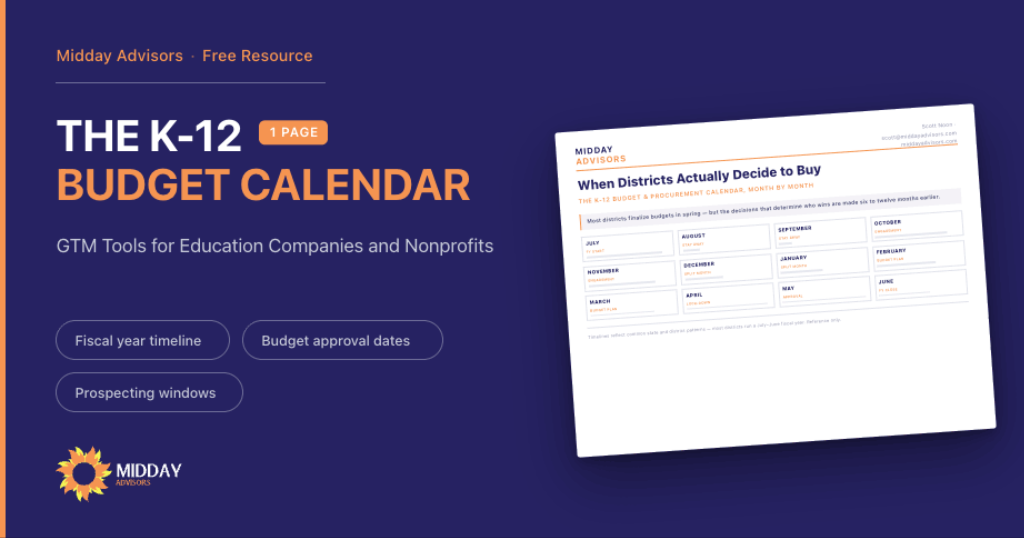
    The K-12 Silence Calendar tells you when districts go quiet and when they don’t. This one-page calendar puts the full cycle in front of you — month by month, with the specific move to make in each one.

    Why Do Sales Teams Keep Misreading K-12 Silence as Rejection?

    Most sales training was built for markets with 60-to-120-day buying cycles. In those markets, non-response after three attempts is a reasonable signal to move on. MEDDIC, challenger selling, SPIN — the major frameworks all assume a cadence where sustained silence means disengagement.

    In K-12, that logic produces false negatives at scale.

    A buyer 14 months from purchase doesn’t respond to follow-up emails in April. Not because they’ve ruled you out — because they’re in a spring planning cycle with no runway to engage a new vendor. The rep interprets that silence through the lens of a 90-day market. They cut the opportunity. They move on.

    The contact comes back in September and finds a different vendor waiting. Not because that vendor is better. Because they understood the calendar.

    The misread is expensive and it compounds. Every false negative in Q2 is a relationship handed to whoever maintained visibility long enough to be remembered when fall starts.

    How to Work With the K-12 Silence Calendar

    The fix isn’t more follow-up. It’s better timing with less friction across the full 12-to-18-month cycle.

    Map outreach to the academic calendar, not the corporate fiscal year. Most edtech companies treat September–December as “fall push.” In K-12, November and December are the worst months to push for decisions. The right timeline runs backward: relationships built in October through early December lead to budget-planning conversations in January through March and lock-down decisions in April, just before summer downtime. If you’re pushing for a close in November, you’re either three months early or seven months late.

    Distinguish dormant from dead. A contact who engaged meaningfully at any point — opened a personalized email, attended a webinar, asked a substantive question — is almost certainly dormant, not done. A contact who never engaged is a different conversation. Build a second CRM status: dormant-calendar. It means still qualified, still signaling interest by prior behavior, currently in a K-12 silence window. Route it to a October re-engagement workflow, not a recycling workflow in April.

    When they go quiet, shift from ask to value. The worst thing a seller can do during a K-12 silence window is send three more “just checking in” emails. Those emails train the contact to filter you out. When a prospect goes quiet, switch from meeting requests to value delivery — a short relevant insight, no reply required. A useful take on a policy trend. A resource related to something they mentioned. Something that keeps your name associated with useful, not persistent.

    The goal during silence windows isn’t to get a meeting. It’s to be the vendor they remember when September starts.

    Build explicit re-entry touchpoints. A September outreach that acknowledges the gap isn’t weakness — it’s proof that you understand how their calendar works. “We talked in the fall — I know spring and summer are busy. Wanted to reconnect as the new year gets underway.” Districts notice the difference between a rep who treats them like a pipeline number and one who operates like they’ve actually sold into K-12 before.

    Getting This Right Changes More Than Your Follow-Up Rate

    The K-12 Silence Calendar isn’t just a reminder to wait. It’s a framework for redesigning how a revenue team builds pipeline, defines engagement, and measures rep performance in a market with a fundamentally different time horizon.

    Teams that understand it stop penalizing reps for “stale” opportunities that are just mid-cycle. They build nurture content for the long windows when buyers can’t respond. They hire sellers who know how to stay warm over 14 months without burning the relationship. They measure deals in academic-year cycles, not fiscal quarters.

    K-12 buyers aren’t ghosting you. They’re following a calendar you haven’t learned yet.

    Learn more at How K-12 Districts Actually Buy: A Field Guide for Education Companies.

    If your team is working through K-12 go-to-market timing and wants to pressure-test your outreach strategy, let’s talk.

    Scott Noon is the founder of Midday Advisors, a K-12 go-to-market advisory firm.

    Frequently Asked Questions

    Why do K-12 district contacts stop responding to sales outreach?

    District contacts go quiet during three predictable windows: September, while schools ramp up for the new year; mid-December through the second week of January, for winter break; and briefly after April’s budget lock-down, once decisions are made. October through early December and January through March are active engagement windows, not silence — non-response outside the quiet periods reflects calendar constraints, not disengagement.

    When is the best time to reach out to K-12 decision-makers?

    October through early December is the primary window for building visibility with new contacts — administrators are genuinely available and shaping next year’s priorities. January through March isn’t secondary — it’s when that visibility converts, as districts run budget-planning sessions and look for vendors who already understand their challenges. September is the wrong time to push, and by April the budget is effectively locked.

    How long does a typical K-12 sales cycle take?

    Most K-12 districts finalize budgets in spring, meaning vendor relationships need to be built six to twelve months before the contract is signed. The full cycle from first engagement to signed contract commonly runs 12 to 18 months, with multiple silence periods built into the academic calendar.

    What do I do when my contact goes dark?

    Mark the contact dormant-calendar rather than dead, stop sending meeting requests, and shift to value delivery — short, relevant insights with no ask attached. Build a October re-entry touchpoint timed to the start of K-12’s genuine engagement window. The goal during silence is to stay visible without becoming a reason they ignore your emails.

    What is the K-12 Silence Calendar?

    The K-12 Silence Calendar is a framework developed by Scott Noon of Midday Advisors that maps three quiet periods each academic year — September ramp-up, the mid-December-to-early-January holiday break, and the days just after April’s budget lock-down — bookending two active windows: October through early December, when vendors build the visibility that pays off, and January through March, when districts run the budget planning sessions where that visibility converts.

  • Why K-12 District Buyers Don’t Trust Vendors — And What Education Companies Should Do Instead

    Why K-12 District Buyers Don’t Trust Vendors — And What Education Companies Should Do Instead

    There is a number that should bother every education company with a sales team.

    B2B buyer research consistently shows that buyers trust their peers at a rate of 73 percent. They trust vendors at 12 percent. Not 12 percent less than peers — 12 percent, full stop. Your K-12 district buyers trust a stranger on an industry forum more than they trust you, regardless of your outcomes data, your case studies, or how good your last demo was.

    Most education companies respond to this by trying to become more trustworthy inside the sale. Better testimonials. Stronger references. A more credible deck. These are reasonable responses to the wrong problem.

    The issue isn’t that you’re not trustworthy. It’s that you’re trying to earn trust during the buying process. For K-12, that’s too late.

    Why Is K-12 District Buyer Trust Harder to Earn Than in Any Other Market?

    K-12 district buyers don’t make purchasing decisions the way most B2B buyers do. The peer trust dynamic is more pronounced in education, and the consequences of ignoring it are more severe.

    A superintendent isn’t checking your LinkedIn profile before she agrees to a first call. She’s calling the superintendent in the next district. She’s asking the curriculum director she’s known for ten years. She’s drawing on what she heard in the hallway at AASA — a conversation that happened months before your outreach landed.

    This is how K-12 procurement actually works. District buyers operate inside dense, long-standing peer networks. Those networks are actively working when your SDR sequence hits their inbox. If you’re unknown in those networks, the best your email can do is prompt someone to ask around — and if no one can vouch for you, the answer they get is silence.

    K-12 buyers also carry more downside risk than most B2B buyers. A poor purchasing decision affects relationships among students, staff, and the board. The bar for vendor credibility is higher because the cost of getting it wrong is higher. A peer recommendation from someone who has already taken the risk carries weight that no vendor-produced content can match.

    Why Do Education Companies Keep Trying to Earn Trust at the Wrong Time?

    Most education companies build their go-to-market strategy around the sale. The website is optimized for the demo request. The content strategy is built to generate MQLs. The SDR sequence is designed to book the meeting. None of this is irrational — these are standard moves. But they’re built for a buyer evaluating you for the first time in a transactional context. That buyer’s trust ceiling is 12 percent.

    Scott Noon, founder of Midday Advisors, calls this the Pre-Sale Trust Gap: the distance between when trust needs to exist — before a district enters a buying process — and when most education companies start trying to build it, which is during the buying process. That gap is where the pipeline disappears.

    The pattern shows up the same way across company after company. A curriculum company with genuinely strong outcomes data loses a deal to a competitor with weaker results. Not on price. Not on features. The competitor was known. Not known from a better conference booth — known because a superintendent mentioned them to a colleague a year earlier. Known because an article circulated in the right administrator network. Known because a newsletter landed in front of the VP of Marketing six months before she had a budget conversation.

    The sale didn’t happen in the sales process. It happened in the eighteen months before the first meeting.

    What Does Pre-Sale Trust Building Actually Look Like for K-12 Companies?

    Pre-sale trust building is the practice of becoming known and credible inside your buyer’s peer network before they enter a buying process. For K-12 companies, it is the highest-leverage go-to-market investment available.

    It doesn’t look like advertising. It doesn’t look like conference sponsorship. Here’s what it actually looks like.

    Getting into peer networks as a contributor, not a buyer of attention. AASA, CoSN, ASCD, state administrator associations — these aren’t just conference opportunities. They’re the peer networks your buyers trust. Education companies that show up as speakers, facilitators, and panelists — not as sponsors with a booth — get mentioned in the conversations that happen after the session ends. That mention is the trust transfer.

    Publishing content that practitioners cite to each other. Not case studies about your product. Not thought leadership about your category. Specific, practical content that a district leader would forward to a colleague because it helps them think more clearly about a real problem. When that forwarding occurs, you’ve completed a peer trust transfer without being present.

    Building a direct audience before you need a pipeline. A newsletter that a curriculum director reads every Tuesday morning puts you in a different category than a vendor. You’re a source. Sources get cited. Sources get forwarded. Sources get mentioned in the conversation before your outreach lands. Most K-12 companies finalize vendor relationships in spring, which means the trust-building window needs to open 12 to 18 months before the contract conversation — not when you need Q3 revenue.

    Earning citations from the right third parties. A case study written from the district’s perspective — in which the superintendent describes the problem in her own words and the outcome in her own terms — reads like peer testimony. A case study written from the vendor’s perspective reads like marketing. Buyers know the difference.

    The Sequence Is the Strategy

    Most education companies treat trust-building as a feature of the sales process. Better rapport. Stronger references. More credible social proof. These things matter at the margin — but they’re working against a ceiling. The 12 percent ceiling that comes with the vendor identity.

    The companies that consistently win in K-12 understand that trust-building is pre-sale work. It happens at the conference dinner, not the conference booth. In the newsletter issue, not the nurture sequence. In the peer recommendation, not the reference call.

    By the time your buyer is in a formal evaluation, the trust question should already be answered. Your name should be one they’ve heard before — from someone they actually trust.

    If it isn’t, you’re not losing on price or features. You’re losing because the relationship work wasn’t done. And you can’t make up twelve months of pre-sale trust-building inside a six-week evaluation cycle.

    The pipeline problem most education companies are trying to solve in Q3 was created — or avoided — in Q1 of the previous year.

    Learn more at How K-12 Districts Actually Buy: A Field Guide for Education Companies.

    If your organization is dealing with a version of this — where the product is strong but the pipeline isn’t moving the way it should — let’s talk. Schedule time with Scott Noon or reach out on middayadvisors.com.

    Frequently Asked Questions

    Why do K-12 district buyers trust peers so much more than vendors?

    District buyers operate in high-accountability environments where a bad purchasing decision has real consequences — for students, for staff, and for their own careers. Peer recommendations from people who have already taken the risk carry weight that the vendor claims can’t match. The trust gap (73% peers vs. 12% vendors) reflects the structural reality that vendors have an obvious interest in the sale, while peers don’t.

    What is the Pre-Sale Trust Gap?

    The Pre-Sale Trust Gap is the distance between when trust needs to exist — before a district enters a buying process — and when most education companies start trying to build it, which is during the sales cycle. Most K-12 purchasing decisions are influenced by peer relationships, conference conversations, and content encounters that predate the formal evaluation by 12 to 18 months. Companies that start building trust when they need a sale are already behind.

    How long does it take to build meaningful trust with K-12 district buyers?

    Most K-12 purchasing decisions follow a 12-to-20-month cycle from initial awareness to signed contract. Trust-building that influences a deal needs to start well before that cycle opens. Education companies that are consistently known in buyer peer networks typically have been building that presence for 12 to 24 months through consistent content, conference presence, and direct audience relationships.

    What’s the difference between content marketing and pre-sale trust building?

    Content marketing is typically designed to generate leads and is measured by traffic, MQLs, and conversion rates. Pre-sale trust-building is designed to shift how buyers perceive you before they enter the buying process — measured by whether your name comes up in peer conversations without you being present. The content can look similar; the intent, the distribution strategy, and the metrics are different.

    How does Midday Advisors help K-12 education companies with this problem?

    Midday Advisors works with K-12 education companies and nonprofits to build the go-to-market infrastructure that creates a consistent, sustainable pipeline — including the positioning, content strategy, and channel approach that moves companies from vendor-identity to trusted-source status in their buyer communities.

  • The Seniority Trap: Why Senior Leaders Are Always Last to Know What’s Happening in the Market

    The Seniority Trap: Why Senior Leaders Are Always Last to Know What’s Happening in the Market

    There’s a specific moment when a senior leader realizes their picture of the market is wrong. Usually it comes from a conversation they weren’t supposed to be in.

    A founder sits in on a sales call and hears an objection nobody raised in the pipeline review. A VP joins a discovery call and hears a pain point that never made it into the messaging. A CEO talks to a churned customer and hears a story that doesn’t match the account team’s version. The information was always there. It just didn’t travel up.

    Scott Noon of Midday Advisors calls this the Seniority Trap: the structural way leadership filters, softens, and averages information until what reaches the executive is a managed version of what’s actually happening in the field. It’s one of the most common and most costly problems in K-12 go-to-market.

    Why do senior leaders lose touch with the market?

    Not because they stop caring, and not because their teams lie. It’s structural. The same habits that make an organization function- summarizing, preparing, contextualizing- steadily degrade the market intelligence that reaches the top.

    Direct reports summarize before they report. The lost deal becomes “budget timing” instead of “the buyer didn’t believe our implementation story.” The stalled deal becomes “waiting on procurement” instead of “our champion lost internal support in March, and nobody flagged it.” A signal that should start a strategy conversation gets turned into a status update, because raising a problem without a solution feels like complaining.

    Dashboards average away the nuance. One conversion rate hides two reps doing fine and three struggling for completely different reasons. Averages are useful for reporting. They’re nearly useless for diagnosing.

    Customer meetings get curated too. The team pre-briefs the client before the executive visit. The conversation is warm, productive, and thin. The executive leaves feeling good about a relationship that’s actually six months from a hard renewal. The quarterly review is the most polished version of all of this: three weeks of prep, a deck reviewed by four people, bad news present but framed. Nobody leads with what went wrong. That’s not deception. It’s normal behavior at every layer of a normal hierarchy.

    Why does this hit K-12 go-to-market especially hard?

    Because the feedback loop is so slow that bad information survives for years. In most B2B markets, a short cycle corrects bad intelligence fast; you learn a deal is lost in weeks. In K-12, decision cycles run twelve to eighteen months, so a filtered picture of the market can drive strategy for two full years before the pipeline data makes the problem undeniable.

    By then the damage is baked in. The company has hired against the wrong ICP, built content for the wrong buyer, and positioned against competitors who aren’t even in the real deals. Most K-12 problems that look like execution problems are actually intelligence problems. The team is executing well against a market picture that isn’t true.

    What does the Seniority Trap look like in practice?

    Picture a mid-market edtech company with a strong product and a flat second half. A promising district deal stalls in the spring. The rep logs it as “lost to budget timing” and moves on. The pipeline review records the same three words. The VP rolls it into a quarterly summary as “timing-related slippage.” By the time it reaches the CEO, it’s one line in a deck: budgets were tight this cycle.

    None of that is false. It’s just sanded down. The real story was different. The district’s champion, a curriculum director, had pushed hard for the product. But the assistant superintendent never got comfortable with the implementation plan, and the board was nervous about a tool in a politically sensitive category. That’s not a budget problem. It’s a positioning and trust problem, and it’s almost certainly repeating in other deals right now.

    Here’s the cost. Because the signal arrived as “budget timing,” the company’s fix is to discount next cycle. The real fix, reframing the implementation story for the economic buyer, never gets built, because nobody at the top ever heard the real reason. A full year of deals gets shaped by a diagnosis that was wrong the moment it left the rep’s mouth.

    How do you break the Seniority Trap?

    Get back into rooms without an audience. The best intelligence comes from conversations nobody prepared for you. A few habits do most of the work.

    Sit in on a discovery or renewal call as a listener, not to grade your team but to hear how the buyer thinks. Ask your best rep what they learned recently that surprised them; reps in front of buyers every week know things that never reach a deck. Talk to churned customers without your team in the room, because customers manage what they tell a vendor they’re still paying. And run skip-levels: a conversation one layer below your direct reports surfaces a signal that usually gets absorbed before it reaches you.

    Then build a system for it. None of these are one-time fixes. The Seniority Trap reasserts itself the moment you stop working against it. The leaders who stay connected to reality do it with a repeating cadence for unfiltered input, not because they have unusually honest teams.

    Senior leaders don’t lose their market instincts. They get separated from the inputs that feed them. Rebuilding that connection doesn’t require reorganizing anything. It just requires getting back in the room.

    Learn more in the Guide: What Is a Fractional CMO, and Does Your Education Organization Need One?

    If your organization is dealing with a version of this, let’s talk. You can also see how we work on our Services page.

    Scott Noon is the founder of Midday Advisors, a K-12 go-to-market advisory firm that works with education companies and nonprofits.

    Frequently Asked Questions

    What is the Seniority Trap in K-12 sales?

    The Seniority Trap is the structural way that leadership positions degrade market intelligence. As leaders rise, information reaching them gets filtered, summarized, and softened by each organizational layer — leaving executives with a managed version of market reality rather than an unmediated one.

    Why are senior leaders often last to know about problems?

    Because the people between them and the field have both the ability and the incentive to process bad news before it travels up. This isn’t dishonesty — it’s normal organizational behavior. Summarizing, contextualizing, and preparing information are the same skills that make teams functional. They just systematically degrade the signal that reaches the top.

    How does the Seniority Trap affect K-12 go-to-market strategy?

    In K-12, where buying cycles run 12 to 18 months, bad market intelligence compounds for a long time before the damage becomes visible in pipeline data. A leadership team operating on a filtered picture of the market can run a flawed strategy for two full years before the numbers make the problem undeniable.

    How can senior leaders stay connected to market reality?

    The most reliable methods are low-tech: attending sales calls as a listener, talking to churned customers without your team present, running skip-level conversations, and asking reps directly what they’ve learned recently that surprised them. These need to be a repeating cadence, not a one-time exercise.

    Is this a management problem or a structural problem?

    Structural. The Seniority Trap reasserts itself the moment you stop actively working against it — regardless of how good your team is. It’s not caused by bad management or dishonest employees. It’s caused by the normal way organizations process and communicate information upward.